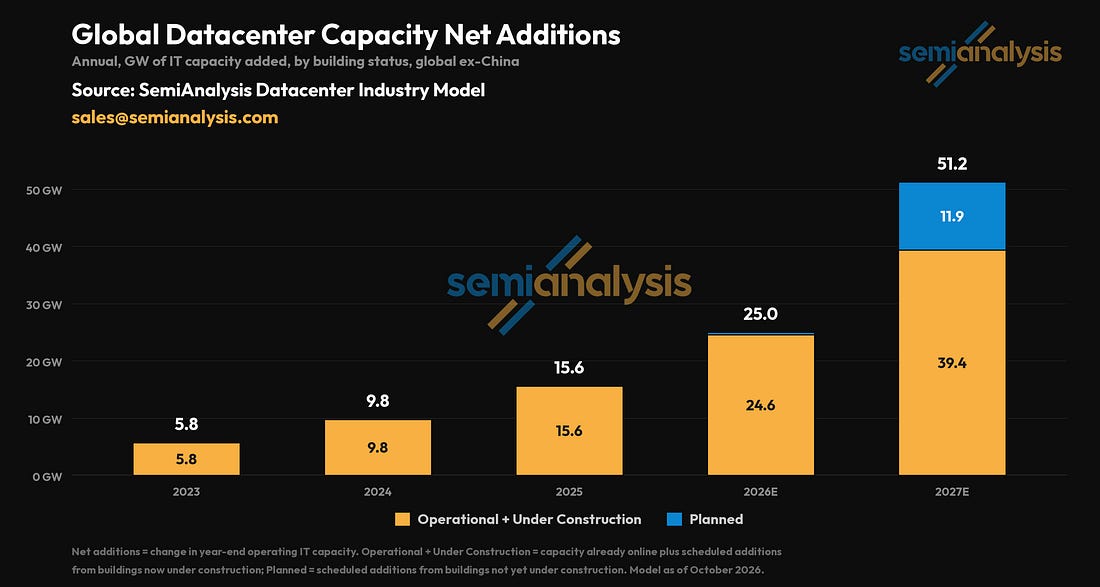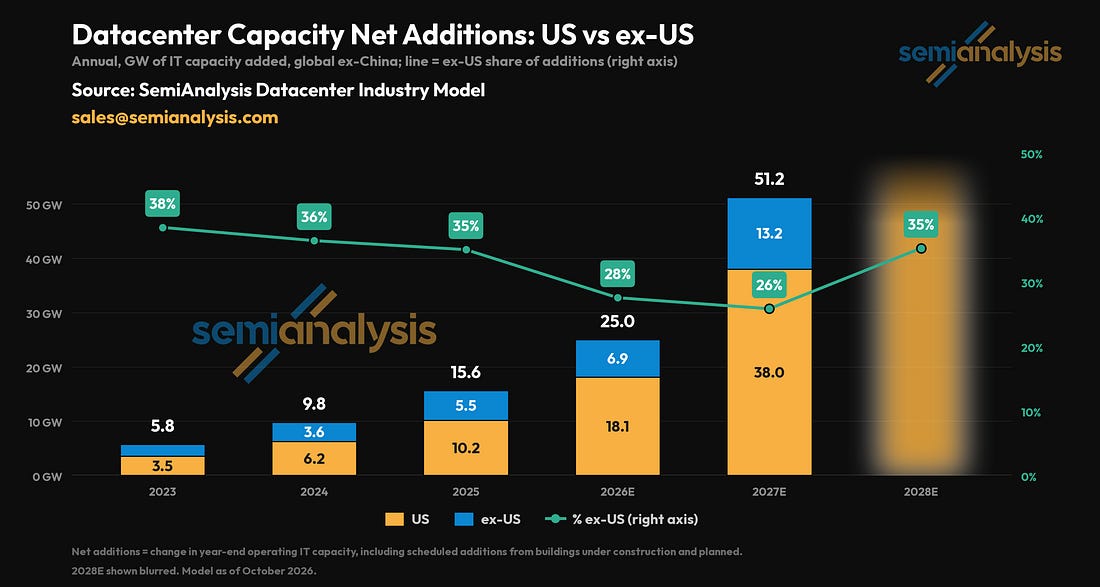
SemiAnalysis forecasts that the world outside China will add about 51 GW of datacenter IT capacity in 2027. That is double 2026's roughly 25 GW, and about equal to the entire global datacenter stock that existed through 2024. They argue this is not a hunch. It is what you see by counting buildings already under construction and the long-term leases already signed and financed. If they are right, 2027 brings a step-change in AI compute supply. The binding constraint then shifts away from buildings and power, and toward chips and capital.
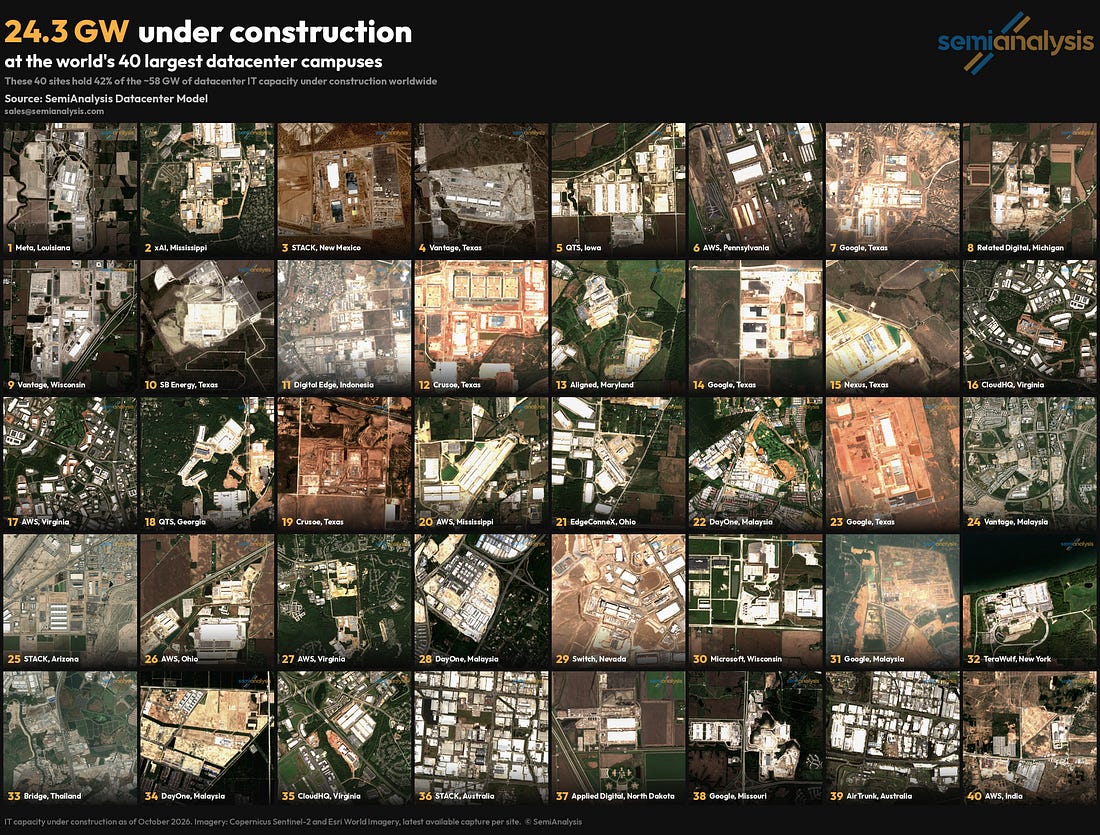
The forecast is a rebuttal. Brad Gerstner, a prominent tech investor, publicly called SemiAnalysis's number too aggressive and guessed about 25 GW instead. SemiAnalysis's answer is to point at concrete. The 40 largest campuses alone have 24.3 GW in advanced construction, slated for 2027 delivery. Most of these sites already have exterior cooling and electrical gear installed. Those 40 campuses are about 42% of the roughly 58 GW under construction globally.
Context: "IT capacity" means power delivered to the servers themselves. The facility's total grid or generator draw is higher, because cooling and electrical losses typically add another 15-40%. So 51 GW of IT load implies something like 60-70 GW of actual generation (my estimate, not theirs).
The growth trajectory, in GW added per year:
| Year | GW added |
|---|---|
| 2023 | 5.8 |
| 2024 | 9.8 |
| 2025 | 15.6 |
| 2026 | 25 |
| 2027 (forecast) | 51 |
Of the 2027 figure, about 39 GW is already operational or under construction. About 12 GW is still in the "planned" stage.
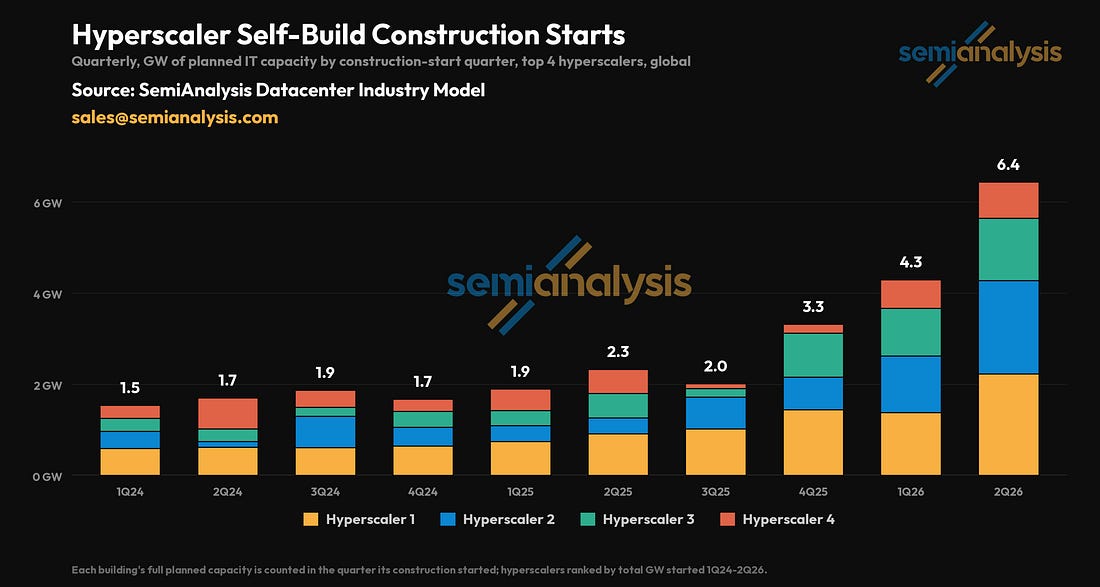
Leading indicator 1: hyperscaler construction starts. "Hyperscalers" are the giant cloud operators: Amazon, Microsoft, Google, and Meta. The capacity they break ground on each quarter has roughly quadrupled, from 1.5 GW in early 2024 to 6.4 GW in Q2 2026. Two of the four drive most of the surge; SemiAnalysis withholds which two.
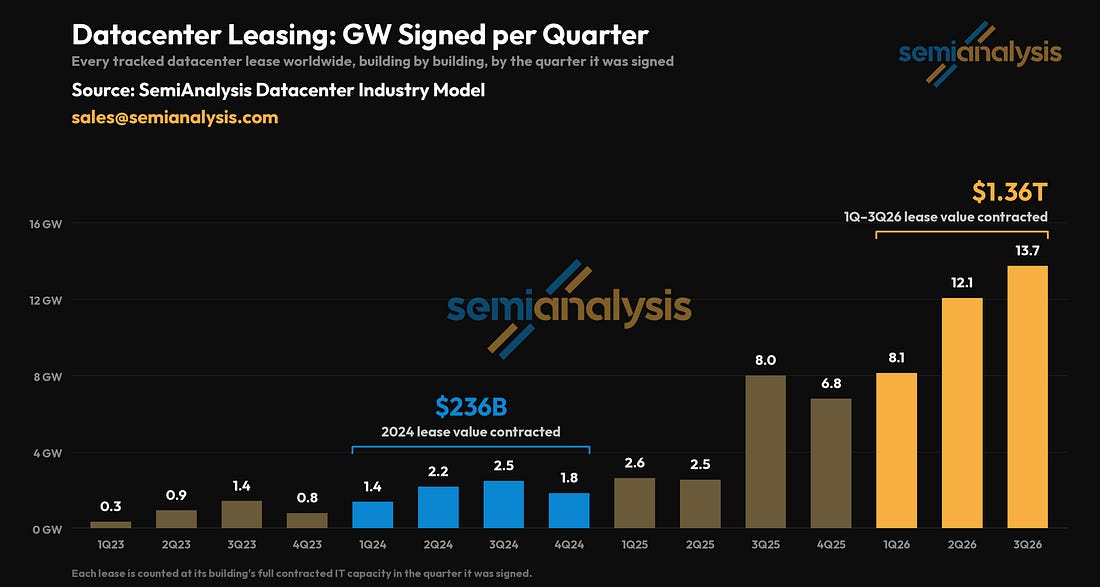
Leading indicator 2: leases, which are the stronger evidence. Developers who build datacenters for tenants typically spend only 5-10% of a project's capital before signing a customer. The signed lease is what unlocks debt financing for the rest. Leases run 15-20 years and are worth $30-50 billion per GW over their life. The causal chain is therefore lease, then debt raise, then construction, with a lag of a year or more.
The chart shows quarterly leasing flat at roughly 1-2.5 GW per quarter from 2023 through mid-2025, then exploding to 8 GW in Q1 2026 and 13.7 GW in Q3 2026. In dollar terms, about $1.36 trillion of binding, non-cancellable lease value was signed in the first three quarters of 2026. All of 2024 saw $236 billion. SemiAnalysis says most of the associated debt has already been raised.
Why 2026 looks comparatively modest. Microsoft single-handedly drove the leasing market in 2023-24, then paused. That pause shows up as a soft 2026, given the lag. Oracle restarted the market with about 4.5 GW of leases in late 2025. The buyer pool is now much broader:
Broader demand is less fragile than one dominant buyer.
How you physically build 50 GW in a year: prefabrication. The main approach is to move work off the construction site and into factories:
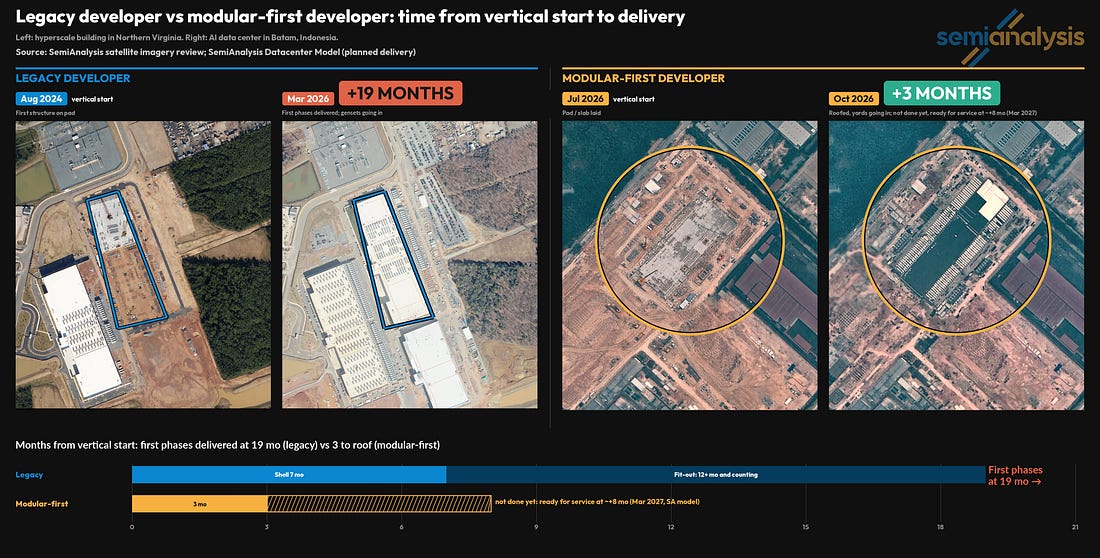
Build times are dropping below 10 months, and onsite mechanical/electrical/plumbing labor falls by up to 63%. Modular-first developers are winning deals on speed. The Singapore-based developer DayOne delivers in about 9 months versus 18+ for traditional builders, and has leased about 3 GW since 2023.
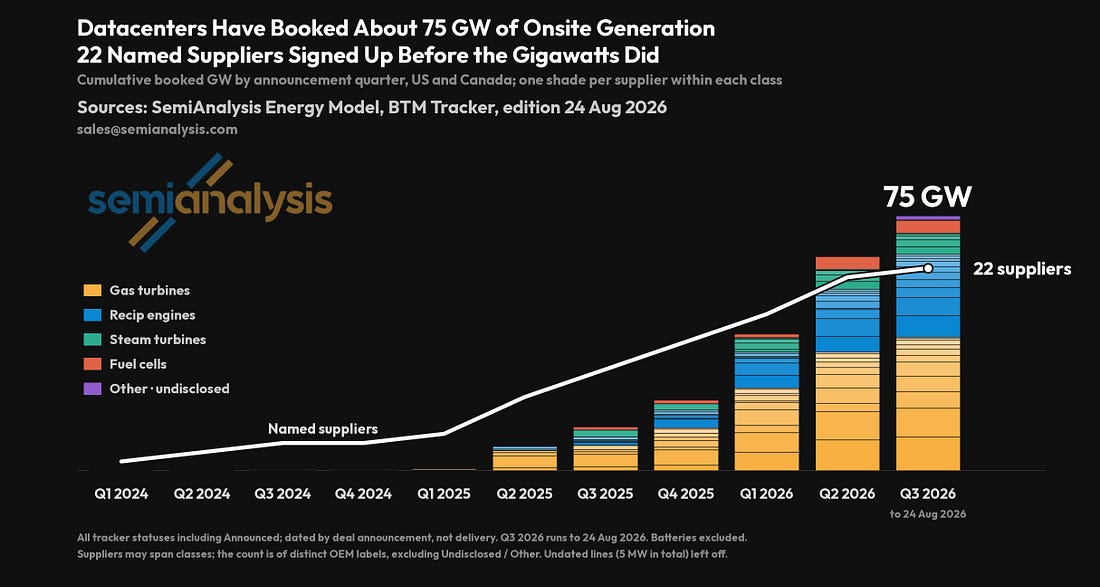
Power: SemiAnalysis claims it is "largely solved," via behind-the-meter generation. Behind-the-meter means building your own power plant on site instead of waiting 5-10 years for a grid interconnection. SemiAnalysis previously projected that US grid headroom goes negative around end-2027. Big gas turbine makers hit production bottlenecks, but new suppliers filled the gap with a range of alternatives:
By Q3 2026, about 75 GW of onsite generation had been booked across 22 suppliers. Gas turbines dominate, and nuclear doesn't feature.
Geography. The US share rises through 2027, with about 38 GW of the 51 GW in the US. SemiAnalysis forecasts a swing abroad in 2028, with the ex-US share rising from 26% to about 35%. The driver is US labor, power, and permitting friction, with Malaysia, Indonesia, Thailand, India, and Australia among the beneficiaries.
Not a week goes without another piece of datacenter FUD. We’ve already debunked depth why moratoriums aren’t as impactful as one may think. Despite that, many still misunderstand the pace of the global AI datacenter buildout. Just the other week, Brad Gerstner from Altimeter showed our data on the All-In Podcast and stated that “SemiAnalysis’ forecast of +43GW in 2027 is too aggressive” and that he thought only about 25GW would get built, close to half of our number, based on his “hunch”. But let’s not operate on hunches.
It’s very tempting to cede to the FUD given all the constraints on the datacenter buildout: power, labor, supply chains, capital, and many more. But at SemiAnalysis, we care about the truth, not about narratives. And here’s the truth for you: one picture, >24GW of datacenters in advanced stage of construction, all to be delivered in 2027. Most of them are more than halfway done, with exterior cooling and electrical equipment already installed. That’s just 40 campuses, a tiny share of the multiple hundred sites in advanced stage of construction. We track them all, and for the full granularity, use our Datacenter Industry Model.
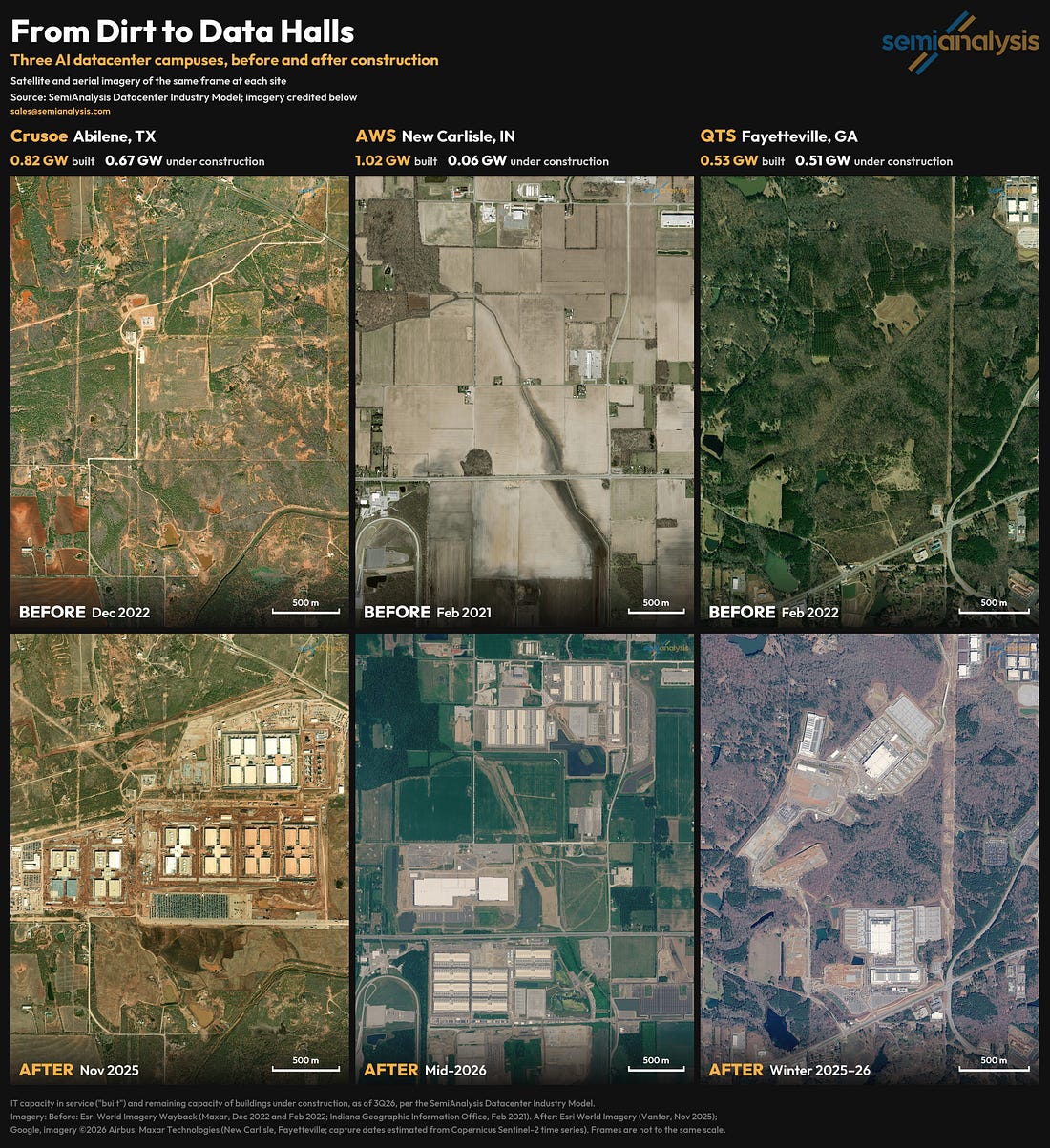
Of course, there are plenty of challenges and shortages. Behind these pictures, there are labor issues, supply chain delays, fundraising challenges, among many others. We’ve written in-depth about Modular Datacenters and Labor, Datacenter Electrical systems, Cooling systems, Behind-The-Meter power, the US Grid Constraints, and Nvidia’s ecosystem financial support. But the fact is simple: gigantic sites are simply getting built, and many are on time. For example, just go look at what Crusoe built in Abilene, what AWS built in Indiana, or QTS/Microsoft’s giant site in Georgia. These are the sites that have produced SOTA technology like GPT-6 and Fable 5.5. Looking ahead, despite all the constraints, an accelerating number of giant sites keep getting built, as shown by our Top 40 picture
If you ask any datacenter builder, they’ll tell you how hard it is, how some workers aren’t showing up, how vendors are delayed, and many other issues. All of this is accurate. And that’s why we’ve successfully called out countless datacenter delays and keep calling out developer timelines that appear overly aggressive in our Datacenter model, including the Oracle New Mexico Force Majure site delay in April. To be fair, +50GW is essentially the global cumulative datacenter market up through 2024 being built in one year! But our Datacenter Industry Model adjusts for all of that and still points to a material acceleration in datacenter capacity in 2027. So, what are we seeing that others can’t?
Let’s dig in. We’ll explore the following topics in this report:
SemiAnalysis proprietary leading indicators: we’ll show a sneak peak of our proprietary data supporting our forecast, such as self-build construction starts and datacenter leasing (in MWs and USD). Year-to-date, slightly under USD 1T of binding / non-cancellable datacenter leases have been signed – that’s key to supporting our aggressive 2027-28 forecast.
The shape of the buildout: how can we support +50GW in a single year? Where, what design, what power solutions?
The “real” question: are we going to face a datacenter oversupply? As we explained in The Great Silicon Shortage, datacenters & power may be the tip of the iceberg, with memory and logic possibly becoming the new #1 constraint in 2027-28.
Overall, we are very excited about 2027. The natural implication of the acceleration will be significantly more compute supply. That means cheaper and smarter AI, faster pace of AI model progress, and likely material revenue acceleration for leading AI labs and other token vendors. That also means unthinkable capex numbers. Reflexively rates will have to shoot up to enable the buildouts from a capital demand perspective. Let’s dive in!
Today we want to dive into two crucial indicators that give us strong confidence on our 2027 forecast. The first one is quarterly self-build construction starts. To accurately forecast US hyperscalers, we track the exact construction evolution of every single building. And the conclusion is simple: US hyperscalers have never launched more construction of datacenters. Each quarter, we track how many MWs start construction, and that number is going parabolic, driven in particular by two hyperscalers. If you want to know who or track the granularity of our data, subscribe to our Datacenter Industry Model.
The second indicator is Datacenter Leasing. We’ve talked about this a lot in prior reports, but as a quick recap: given the capital-intensity of building multi hundred MW datacenters, developers typically only spend 5-10% of project capital without a customer. They need a “pre-lease” to fund and develop the whole project. That’s typically a 15-20 year contract, with a TCV of $30-50B per GW. Check out our HPC Lease Tracker as part of the Datacenter Model to dive into actual contract economics.
As such, tracking these lease contracts is a key leading indicator, as it leads debt raises, which itself leads the actual buildout. A big reason why 2026 datacenter growth isn’t “that” high relative to 2025, is that quarterly datacenter leasing remained relatively stable between H2 2023 and H1 2025. Of course, the key reason was the Microsoft Datacenter Freeze, which we called out before anyone else in December 2024 for Datacenter model subscribers: the Redmond giant single-handedly drove the leasing market in 2023 and 2024, then paused, and others could only pick up what was left behind.
Since H2 2025, things have dramatically changed. Oracle kicked off the era of gigantic leases, after closing on ~4.5GW of datacenter IT capacity across three sites between August and October 2025. Everyone else followed, and the pool of buyers has never been broader, with Meta, AWS, Microsoft, Google, Nvidia, AMD, Anthropic and OpenAI all being in the market for GW-scale leases. There’s also a long tail of Neoclouds signing hundred-MW-scale deals.
In USD terms, this means an unprecedented amount of lease value that builders can use to raise debt. Just in 2026 year-to-date, we’ve identified over a trillion USD of lease value that was signed and closed. That trillion is supporting a gigantic datacenter buildout in 2027-28. Our new Compute, Capital & Markets Model is now tracking all the debt raises and can confirm that most of this debt has been raised.
Tracking all of these leading indicators has enabled us to forecast, before anyone else, the upcoming surge in orders for many industrial suppliers like Vertiv, ABB, Sterling Infrastructure. Check out our Industrials Model for in-depth coverage. However, the challenge is now going from orders to delivery. And resources have obviously become constrained, as power, labor, and sheer regulatory overhead are enormous burdens for developers. But the industry has promptly reacted with innovation.
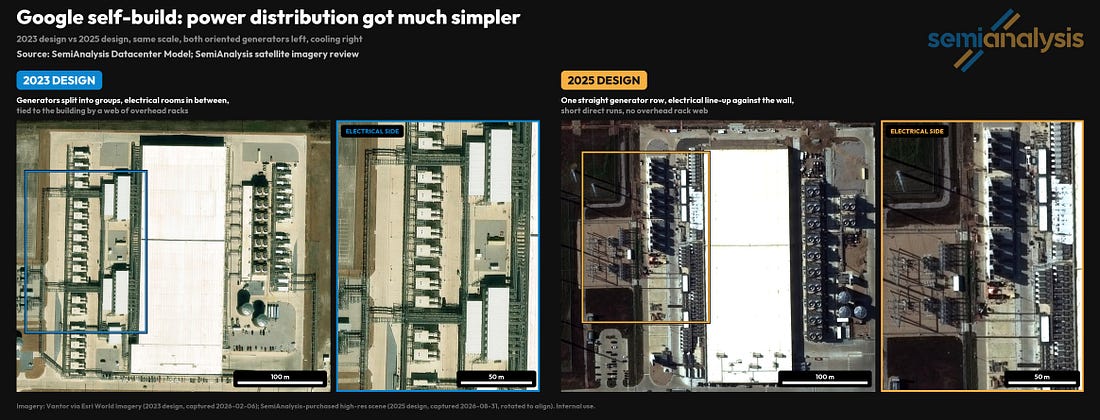
The first step is to simplify datacenter designs. We show below how Google has modularized their electrical architecture, removing a significant amount of outdoors cabling that requires onsite assembly, replacing them with prefabricated electrical modules. We track all the equipment changes (including suppliers) for datacenter designs and forecast orders in our Industrials Model
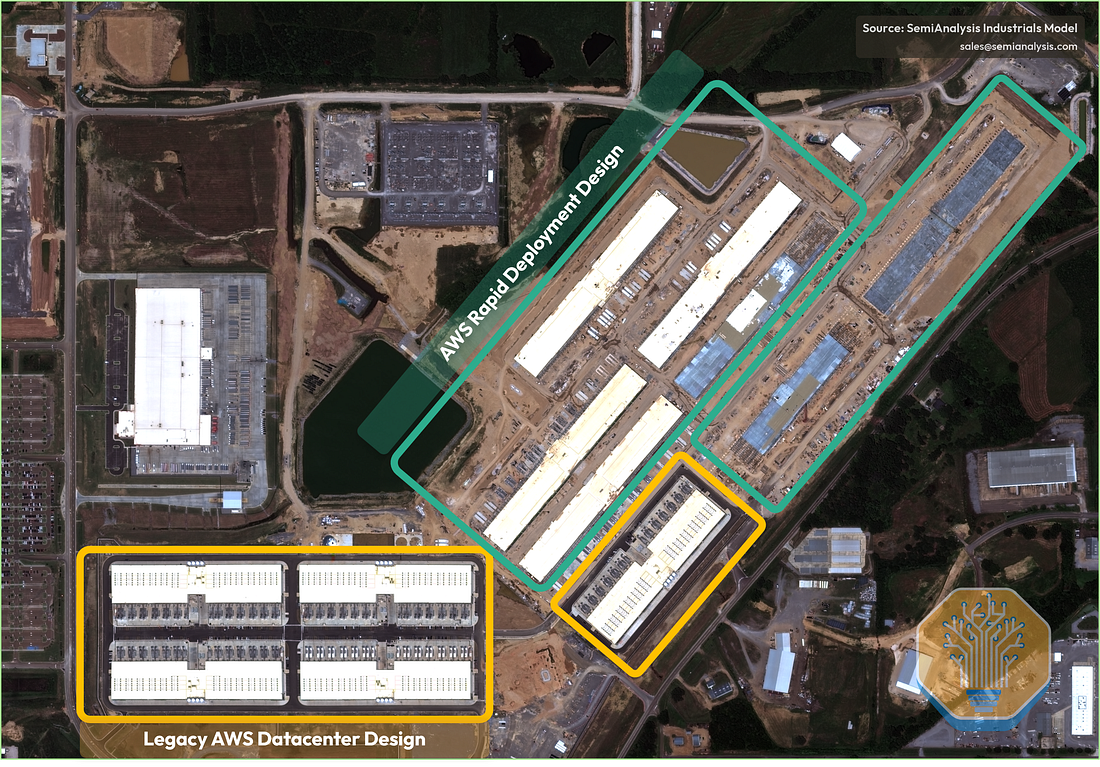
Others have opted for more radical design changes. One example is Meta with its tent design, that we exclusively unveiled over a year ago. Another one is AWS which has materially simplified their shell design and launched a new rapid design dubbed “SAMDC”. Data halls are also increasingly prefabricated, an effort called Project Houdini at AWS. Construction timelines are now under 10 months. Hence our “LEGO Datacenters” title for the modular movement, you literally slot them in and go, and doing so allows for MEP labor (7-11 months of work) to drop up to 63%! We will have a full deep dive on the labor of the 2027 buildout coming soon.
In addition to hyperscale selfbuild, datacenter developers promoting prefabricated designs have also been remarkably successful. DayOne is likely the best example. With a total of ~3GW leased since their first deal in early 2023, the Singaporean company has been a rocket ship in terms of construction speed. While traditional developers have >18 months build timelines, DayOne cut this to ~9 months, which was key to signing huge deals with Firmus, OpenAI and Nvidia.
Another core issue is power, and again we think the issue is largely solved. We’ve been the first to talk about all issues on power, since March 2024 and subsequently given the grid headroom dips negative at the end of 2027. This ended up driving AI Labs and hyperscalers to build their own power plants, better known as Behind-the-meter generation, bypassing 5-10year grid interconnection timelines. And while turbine incumbents like GEV quickly faced production bottlenecks, the industry quickly reacted and we’ve since seen a surge in new OEMs and new solutions supplying the market. From fuel cells to truck engines to refurbished turbines, the power generation problem has broadly been solved.
In addition, the buildout is now geographically diversifying. This naturally bypasses US labor, power, and (in some countries) permitting constraints. And as shown below, the ex-US buildout is sharply accelerating in 2027, and we expect it to gain a lot of market share in 2028, largely driven by US challenges.