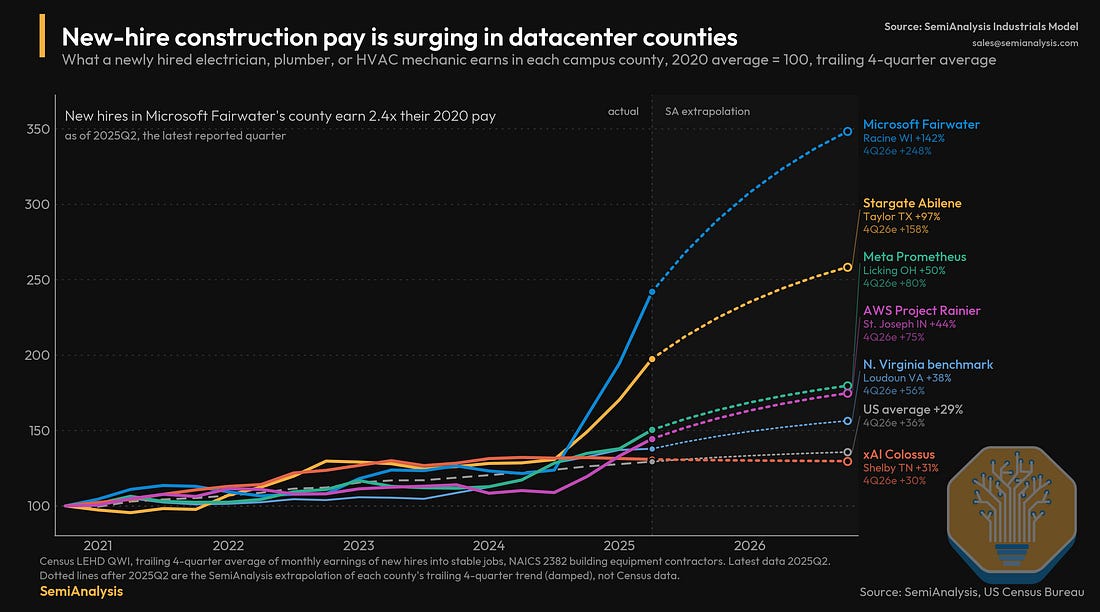
Wages tell the story. In counties hosting the marquee builds, new-hire pay for electricians, plumbers, and HVAC mechanics has detached from the national trend — Microsoft's Fairwater site in Racine County, Wisconsin shows new-hire pay up ~242% versus 2020, against ~29% for the US average. Crusoe reportedly raised wages 30% to staff the Stargate site in Abilene, Texas, which peaked above 9,000 workers.
(Index of new-hire construction pay, 2020 = 100, by county. The datacenter counties diverge sharply from the US average and from the Northern Virginia baseline.)
The aggregate picture: SemiAnalysis translates their state-by-state buildout forecast into trade-hours and compares against a "reachable" labor supply — reachable meaning workers who can plausibly be drawn to a given state, which shrinks as other states compete for the same people.
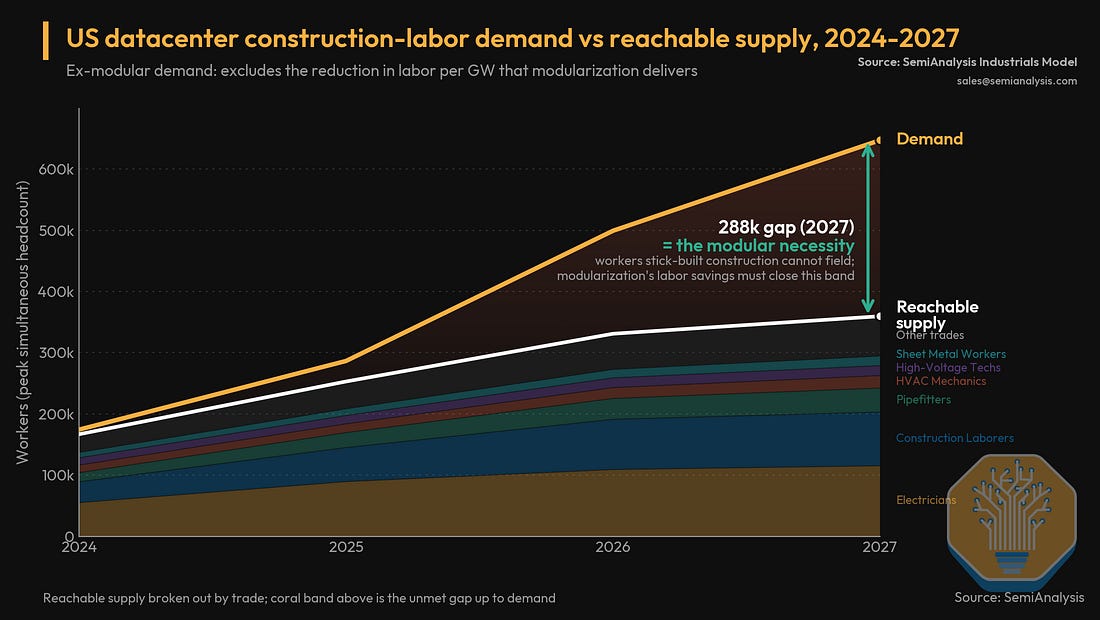
(Demand vs. reachable supply for datacenter construction trades, 2024–2027. The gap opens to ~288k workers by 2027. Note this curve is deliberately drawn ex-modular — it assumes labor-per-GW stays flat, so the gap is precisely what modularization has to close.)
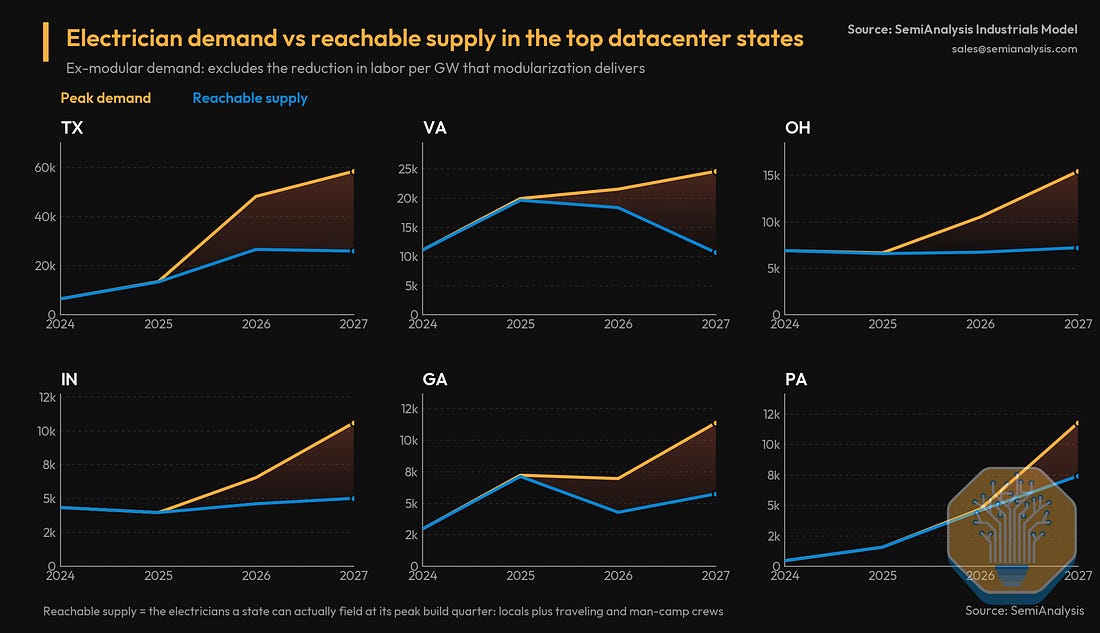
The shortage is worst where the buildout concentrates: Texas (demand ~60k electricians vs. ~25k supply by 2027) and Ohio. This is SemiAnalysis's own model, not observed data, and the "reachable supply" concept is doing a lot of work — but the direction is corroborated by the wage data.
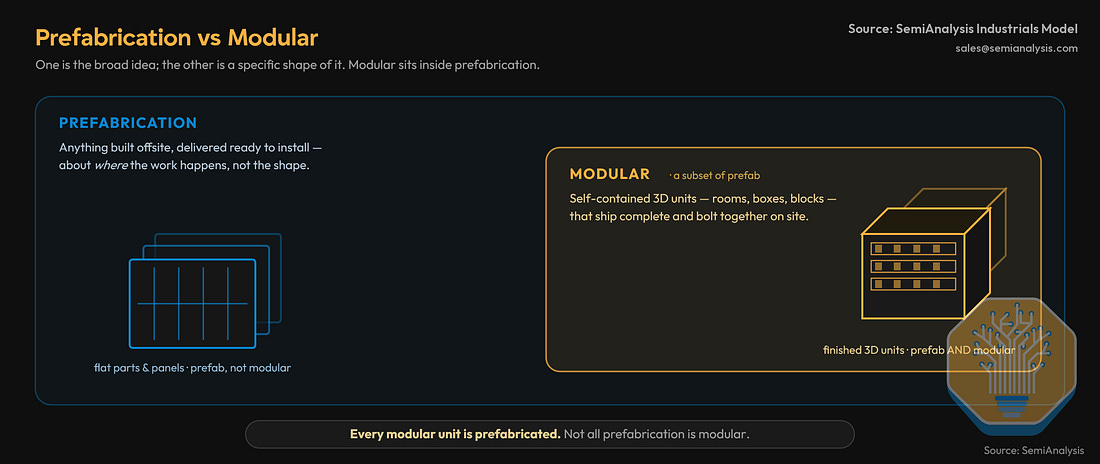
Prefabrication is any work done in a factory and delivered ready to install. It's a claim about where the work happened. A flat concrete wall panel is prefabricated.
Modular is narrower: self-contained three-dimensional units — rooms, boxes, blocks — that ship complete and bolt together on site. Every modular unit is prefabricated; not all prefabrication is modular.
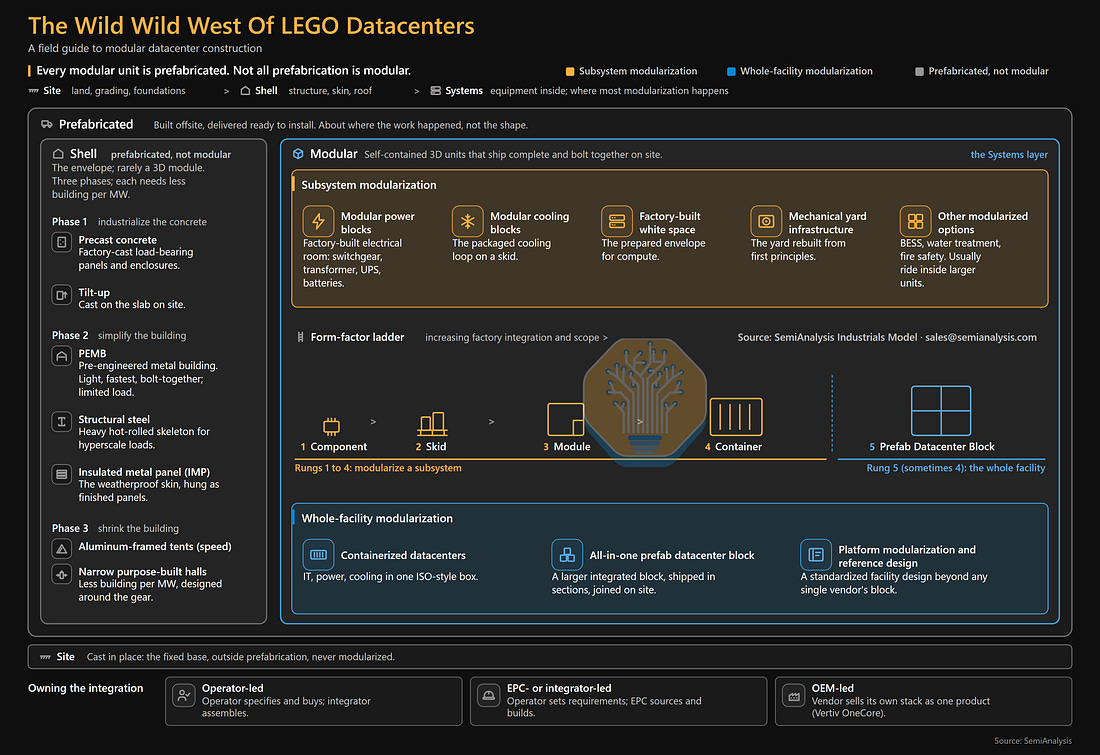
A datacenter has three layers: site (grading, foundations, buried utilities — cannot be moved to a factory), shell (structure, walls, roof), and systems (power and cooling equipment). Modularity increases as you go up.
Phase 1 — precast concrete. Instead of forming and curing concrete in the field, panels are cast in a plant and craned onto a prepared foundation. This matters because cast-in-place concrete requires each pour to reach ~75% of design strength before the next goes on top; precast eliminates the wait. SemiAnalysis puts the shell sequence at ~15 weeks traditional vs. ~11 weeks precast (~29% faster). Northern Virginia has done this for years precisely because labor was already tight. But precast alone still delivered CloudHQ's two-story Ashburn facility in 18–20 months — you industrialized the same building.
Tilt-up is the cheap variant: panels cast on the building's own slab and tilted upright. No long-haul trucking, but quality and schedule stay exposed to weather.
Phase 2 — simplify the building. The bigger gain came from abandoning the dense multistory facility for repeatable single-story halls with standard structural bays. At the light end is the pre-engineered metal building (PEMB): a primary steel skeleton, lighter secondary framing between the main frames, and a thin metal skin — all arriving cut, punched, and labeled for bolt-together assembly. Heavier halls use conventional structural steel, which costs more but allows wider column-free spans.
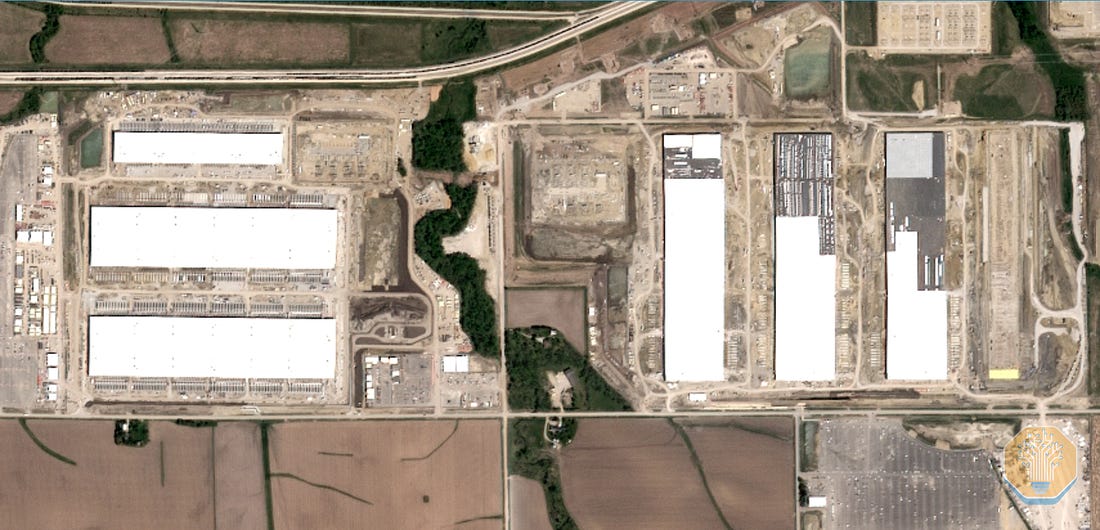
The scale this unlocks: QTS's Cedar Rapids campus, 420 MW and ~2.8 million square feet, used ~28,000 tons of structural steel and went from groundbreaking to topping out in about five months, with the building delivered in ~11. At Abilene, each building used ~672 factory-made insulated metal panels, fabricated in under 40 days and installed at 15–20 per day, getting each building weathertight in under eight weeks.
The trade-off is land. Single-story campuses need far more acreage — acceptable in new AI markets where land is cheap and speed is worth more than MW per acre.
Phase 3 — purpose-built rapid-deployment shells. Meta's "tent" halls at the Prometheus campus in New Albany, Ohio are the extreme case: aluminum frames with fabric cladding, ~125,000 square feet each, providing enclosure and weather protection without a permanent building. Satellite imagery showed eight standing by April 2026 against a July 2025 announcement.
Important caveat the article makes itself: this does not mean Meta built a datacenter in nine months. The tent accelerates the enclosure only — not the utility interconnection, the power equipment, the cooling, or commissioning. And it trades away durability and future flexibility. AWS is moving the same direction with a design SemiAnalysis calls "SAMDC": narrower, repeatable structures shaped around the systems that go inside, meaning less building per MW and fewer field interfaces.
This is where most of the actual market is. The vocabulary, in ascending order of factory integration:
Levels 1–4 are subsystem modularization: one part of the datacenter arrives assembled and tested, but still has to be integrated into the facility. Levels 4–5 shade into whole-facility modularization.
Context: The industry splits a datacenter into white space (the raised-floor rooms where server racks live) and grey space (everything supporting it — switchgear, uninterruptible power supplies, chillers, pumps, batteries). "MEP" means mechanical, electrical, and plumbing — the trades that fit out the grey space and connect it to the white space. MEP fit-out is where the electricians are, and therefore where the labor bottleneck bites.
A power module packages the electrical train — transformer, switchgear, uninterruptible power supply, batteries, distribution — into one enclosed factory-built room, often including the overhead busway (the rigid bar conductor that feeds power along a rack row) that bridges to the data hall. Electrical fit-out and commissioning on a 50 MW hall runs 5.5–16.7 months built conventionally.
SemiAnalysis's estimate: moving just the power scope to the factory — roughly 26% of the build by content — gets a hall to IT-ready ~22% faster (~13 months vs. ~16.7) and ~5% cheaper per MW, mostly by compressing MEP fit-out from ~5.5 months to ~2.5.
A newer subcategory: "software-defined" power routing. Rather than boxing up the conventional transformer→switchgear→UPS→battery chain, companies like DG Matrix replace parts of it with solid-state power electronics offering multi-port routing — grid, onsite generation, storage, and DC loads all connected through one controlled platform.
Weaker case at first glance — fewer discrete pieces to pre-assemble. Most of the effort goes into skidded coolant distribution units (CDUs), which sit between the facility's chilled-water loop and the loop that actually runs through the servers, isolating the two. Airedale by Modine ships a 2 MW-class CDU on a skid complete with buffer tanks and leak detection; site crews connect two loops and a power feed.
The stronger case is the outdoor mechanical yard, where prefabricating the piping removes large amounts of civil, pipefitting, and controls work — increasingly valuable as liquid cooling multiplies the pipe count. QTS is prefabricating most of its piping infrastructure.
Context: Much datacenter cooling gear was originally designed for hospitals and industrial process cooling, not gigawatt campuses. At this scale you get problems the original design never contemplated — hundreds of co-located chillers recirculating their own hot exhaust, and campus-scale heat islanding.
New entrants are attacking the whole yard. Karman Industries' CO₂-based heat processing unit borrows silicon-carbide power electronics and permanent-magnet motors from electric vehicles and compact turbomachinery from aerospace, claiming 4–5x conventional power density and 60–80% less yard footprint. (Vendor claim, unverified.)
Replaces the hand-built data hall: a pod arrives with rack positions, overhead busway, containment for hot air, the technical water loop, and cabling all pre-installed. Schneider's EcoStruxure Pod takes up to 40 racks. The interesting part is the product-design problem — a factory white space has to serve many chip configurations, so Schneider maintains 30+ reference designs co-developed with Nvidia. The buyer picks the design matching its silicon and gets a hall pre-coordinated with the matching power and cooling modules.
Containerized datacenters put everything — racks, power, batteries, cooling — into an ISO container. The point is transportability. Real market is edge computing, industrial sites, and low-latency inference at a fixed location; not hyperscale. The limitation is that the same fixed form factor that makes it portable caps the density.
All-in-one prefab blocks are the ambitious version. Vertiv's MegaMod 1 MW reference design runs roughly 26.5 m × 24 m × 4 m (MegaMod Plus goes to 31 m wide) — far too large to ship whole, so it's broken into transportable sections, heavy-hauled, and reassembled and commissioned on site.
Platform modularization is the newest layer: a standardized reference design for the entire facility. Nvidia's DSX, first shown as a digital-twin blueprint in October 2025 and formalized as the Vera Rubin DSX reference design in March 2026, covers compute, networking, storage, cluster design, and the facility side — power, cooling, controls, even civil and structural design. DSX Max-Q optimizes tokens per watt within a fixed power budget; DSX Flex handles grid interaction, modulating power draw and coordinating with onsite generation.
Context: This is a significant strategic move worth noticing. Nvidia already dictates the rack and the network; DSX extends its reference architecture out to the concrete and the switchgear, with an ecosystem spanning Cadence, Eaton, Jacobs, Schneider, Siemens, Trane, and Vertiv. Vertiv's OneCore packages power and cooling into standard 12.5 MW pods that snap into DSX deployments. If it sticks, Nvidia effectively sets the design language for the whole physical plant, not just the compute.
EdgeConneX estimates a common reference design can carry a project to a 30–60% complete permit set before site-specific localization even begins — meaning a lot of off-site work starts earlier.
This is the part that determines where the money goes. Three models:
Operator-led. The operator engineers the spec, buys the equipment directly as owner-furnished gear, and hires an integrator purely to assemble. Requires deep in-house engineering and willingness to carry all inventory and lead-time risk — you're competing for scarce transformers and switchgear without a vendor's allocation leverage. Effectively confined to the largest hyperscalers. AWS engineers its own prefab data-hall skids under Project Houdini with Cupertino Electric as design partner. Aligned Data Centers does a hybrid: it owns the architecture and commissioning, but uses external partners for factory floor space.
Context: "Owner-furnished equipment" means the customer buys the hardware itself rather than having the contractor buy it and mark it up. Upside: control and no markup. Downside: if the transformer shows up nine months late, that's entirely your problem, and you've tied up capital in inventory.
EPC/integrator-led. An engineering-procurement-construction firm or specialist integrator buys third-party equipment, assembles it into a skid or module, tests it, and delivers finished construction scope. Vendor-agnostic, so the operator keeps design control while the contractor moves the sequence from a jobsite into a shop. Players include construction firms with the shop footprint — Comfort Systems (running Environmental Air Systems and TAS Energy across 3.5M+ sq ft of shop floor in Texas and North Carolina), Sterling Infrastructure, Quanta's Cupertino Electric — plus specialist modular integrators like PCX, Nautilus, Infra Partners, and Bladeroom.
OEM-led. The equipment maker sells its own integrated stack as a product — Vertiv OneCore is power, thermal, and IT infrastructure inside a Vertiv steel shell. This is the value-capture play: Vertiv's addressable content goes from ~$3.5M/MW selling components to ~$7M/MW selling the block.
The OEM constraint is real: Vertiv's modular lead times exceed 12 months, and Vertiv, Schneider, and Siemens are all rationing factory slots — imposing minimum sizes and favoring large projects. That's actively pushing smaller developers toward the independent integrators.
Design must be frozen early. In a field build you can change your mind mid-construction. In a modular build the design has to be locked before anything ships. The critical work is at the facility level, not the module level: defining loads, selecting equipment, drawing the single-line diagram (the schematic of the whole electrical distribution path), and running short-circuit, protection-coordination, and arc-flash studies in tools like ETAP and PSS/E. These depend on the entire path from the utility connection downstream, so they can't be done on an isolated skid.
For conventional 415/480 volt AC distribution this is well-templated. For the emerging 800 volt DC architecture it isn't — a handful of reference designs exist but none are mature, so architectures are still being worked out one at a time. Aran Industries is building software that plugs into ETAP, PSCAD, PSS/E and Revit to compress a >2-month, multi-engineer electrical design into hours of compute plus one reviewing engineer.
Documentation splits. What leaves design is three package sets: issued-for-fabrication (shop drawings telling the factory how to build it), issued-for-construction (telling the site how to receive, place, and connect it), and a permitting/commissioning set. Automating the design model means these generate from one source instead of being hand-redrawn by different parties.
Factory acceptance testing (FAT) happens at two levels: inspection gates at each assembly station, then a full power-up of the finished unit at rated load before it ships. The industry frames this as the 1-10-100 rule — a defect costs $1 to fix in design, $10 once production starts, $100 after shipping. Standardization makes the test procedure repeatable across units, which is the real gain.
Developers told SemiAnalysis this is the main practical challenge of equipment modularization, which is why integrators are expanding footprints closer to customer sites.
Federal law sets the no-permit envelope at 102 inches wide and 80,000 lb gross — leaving about 24 tons for the module itself on a standard deck. Microsoft's Azure Modular Datacenter and Schneider's Easy Modular fit inside a 40-foot ISO container at 96 inches wide, so they cross state lines (or fly in a C-17) permit-free.
Past that, the cost of permits is trivial — $15–100 per state, with line-haul at $12–14 per loaded mile making a 500-mile move only $6–7k per trailer. The real cost is schedule. Loads past roughly 16 feet become "superloads," triggering a bridge-engineering review of 7–21 days per state, which stacks toward months across a route, plus escorts and restricted travel windows. Thresholds aren't uniform: a module engineered to clear Virginia (superload at 18 feet or 250,000 lb) still trips Ohio's 14-foot, 120,000-lb line.
Transport also becomes a reliability question — a module may see more mechanical stress in transit (vibration, braking, loading) than in its entire service life. Aligned shipped a 3 MW module from Utah to Omaha and back instrumented with force loggers just to characterize it. And insurance constrains loading: high-value AI racks may ship one or two at a time because concentrating more on one trailer creates an unacceptable insured loss. SemiAnalysis reports a truck carrying a large UPS module tipped over in West Virginia en route to Northern Virginia, with a large reimbursement.
So operators design around the haul: AWS engineers Houdini skids onto low double-drop trailers to clear bridges; Nautilus barged a datacenter 50 miles to the Port of Stockton; Compass put a Schneider module factory next to its Red Oak campus.
Stick-build — conventional construction where everything is assembled in place on site, piece by piece; the baseline modular is measured against. Prefabrication — any work done off-site in a factory and delivered ready to install. Modular — the subset of prefabrication that ships as complete self-contained 3D units that bolt together. Skid — components pre-mounted and pre-connected on an open steel frame, shipped as one unit. Module — a skid with walls and a roof; a factory-built room. White space / grey space — the rooms holding server racks / everything supporting them (power, cooling, batteries). MEP — mechanical, electrical, plumbing; the trades that fit out grey space. Where the labor bottleneck concentrates. EPC — engineering, procurement, construction; a contractor who does all three, potentially including factory assembly. Colo (colocation) — an operator who builds and runs datacenter space leased to tenants rather than for its own compute. PEMB (pre-engineered metal building) — a light steel building shipped pre-cut and pre-punched for fast bolt-together erection. Precast / tilt-up — concrete panels cast in a remote plant / cast on the building's own slab and tilted upright. Busway — rigid bar conductor running overhead along a rack row, replacing bundles of cable. UPS (uninterruptible power supply) — battery-backed power conditioning between grid and IT load. Switchgear — the assembly of breakers and protection that routes and isolates power; 12–18 month lead times. CDU (coolant distribution unit) — heat exchanger and pumps isolating the facility water loop from the loop running through servers. CRAH (computer room air handler) — the air-cooling unit inside a data hall. BESS — battery energy storage system. Single-line diagram — the master schematic of a facility's electrical distribution path. ETAP / PSS/E / PSCAD — standard power-system simulation tools for short-circuit, protection, and arc-flash studies. FAT (factory acceptance test) — powering up and load-testing a module at the factory before shipment. IFF / IFC — issued-for-fabrication (drawings for the factory) / issued-for-construction (drawings for the site crew). Superload — an oversize shipment (roughly >16 ft tall) triggering per-state bridge engineering review, 7–21 days each. DSX — Nvidia's reference architecture for a complete AI datacenter, extending from compute out to power, cooling, and civil design. NEMA-rated skid — enclosure rated for outdoor/weather exposure per National Electrical Manufacturers Association standards.
Today we dig into the world of datacenter construction, because how datacenters are built now bears little resemblance to how the industry has historically done it. Concrete walls arrive as finished panels, mechanical and electrical rooms arrive wired, and sometimes even entire data halls arrive on the back of a truck. Some of the largest datacenters in the world are increasingly assembled the same way you assemble your new Spider-Man LEGO set, only that the bricks weigh 50,000 pounds and are a tiny bit more complex. This is the world of modular construction.
From Hyperscaler to Colos to now even the AI labs, modular construction has become the default playbook for building fast. Our Modular Tracker, included in our SemiAnalysis Industrials Model, tracks over 61GW of modular capacity and 1,000+ sites using some form of modularization or prefabrication strategy. Full breakdown by modular category and equipment type is included in the Industrials Model. We estimate that modular penetration will reach 30%+ of total live capacity by the end of 2028.
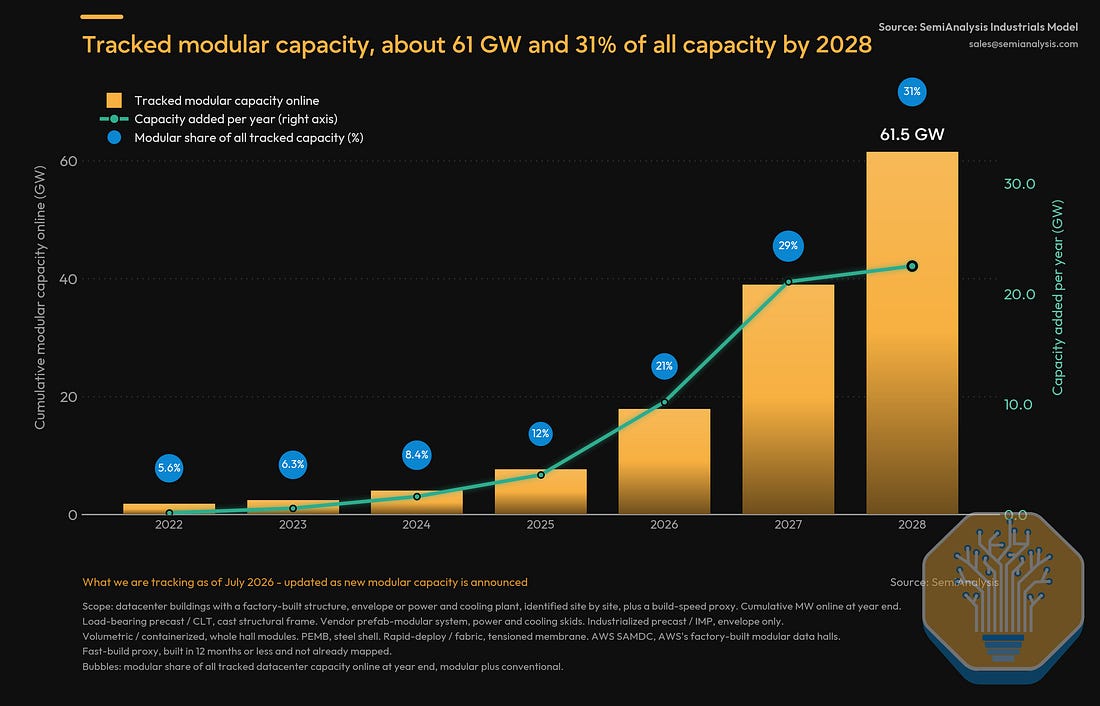
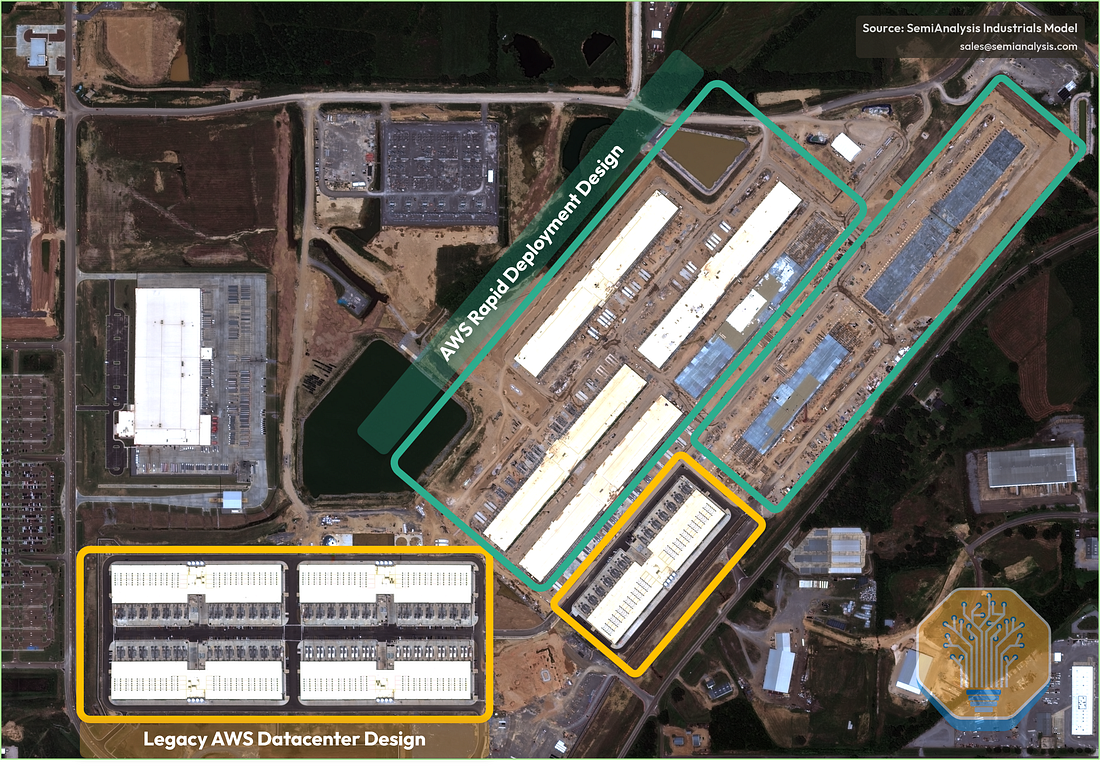
Ultra-fast modular designs are increasingly the norm. Over a year ago, we were the first to call out Meta’s drastic change to using “tent” buildings. As shown below, AWS is now rolling out at very large scale their own modular design codenamed “SAMDC”.
To understand the reason, we need to start looking at one of the structural bottlenecks that capitalist incentives alone cannot build past: labor.
Our recent articles have been a journey toward that bottleneck. In “The Case for Space Datacenters”, we showed the ceiling on terrestrial capacity. Last month, in “Stop Saying Half of 2026 US Datacenter Capacity Is Canceled”, we argued that most bottlenecks are misunderstood and solvable. Trade labor is an exception here, as you cannot quickly solve for a shortage of electricians and pipefitters. The race for that talent became a true constraint long ago, visible when operators like Crusoe pumped wages by 30% to bring talent to Abilene’s site, which required over 9,000 workers at its peak.
Aiming to size the labor shortage trade by trade, we now also include the Labor Model as part of the Industrials Model. It translates the state-by-state buildout from our Datacenter Model into hours of demand for every trade and sets them against reachable labor supply. To frame the problem before modularization enters the picture, the chart below is ex-modular construction, with labor demand curve assuming labor per GW stays roughly flat over the forecast period and doesn't yet reflect the benefits we'll cover later in this article. Reachable labor supply in each state, on the other hand, is affected by how much capacity is being built, and how much labor is being pulled, in other US states.
Electricians are a clear case, as they represent 30-40% over the total construction man hours in a datacenter project. The chart below shows an estimated electrician shortage emerging in 2027 driven by the huge mission-critical demand. On a state-by-state basis, the shortage is most acute where the buildout concentrates, like Texas and Ohio.
The response is that every operator and vendor are now racing toward modularization, which essentially means pulling repeatable work off-site and into factories, where everything from wall panels to power rooms and cooling skids are built in parallel with the site and delivered as finished units. Besides, it does more than ease the labor crunch, promising large speed and time-to-build gains. And today, speed is revenue.
The shift is already underway, with Compass and Switch being the first operators to move parts of their datacenter builds offsite. Using some form of skidded solution for electrical equipment is now pretty standard for every operator. AWS’s Project Houdini prefabricates the white-space buildout and collapses the time before servers go in from months to weeks. Meta is standing up fabric-clad “Tent”-like halls. And a wave of new entrants, both in the OEM and the System Integrator space, are building specifically around modular.
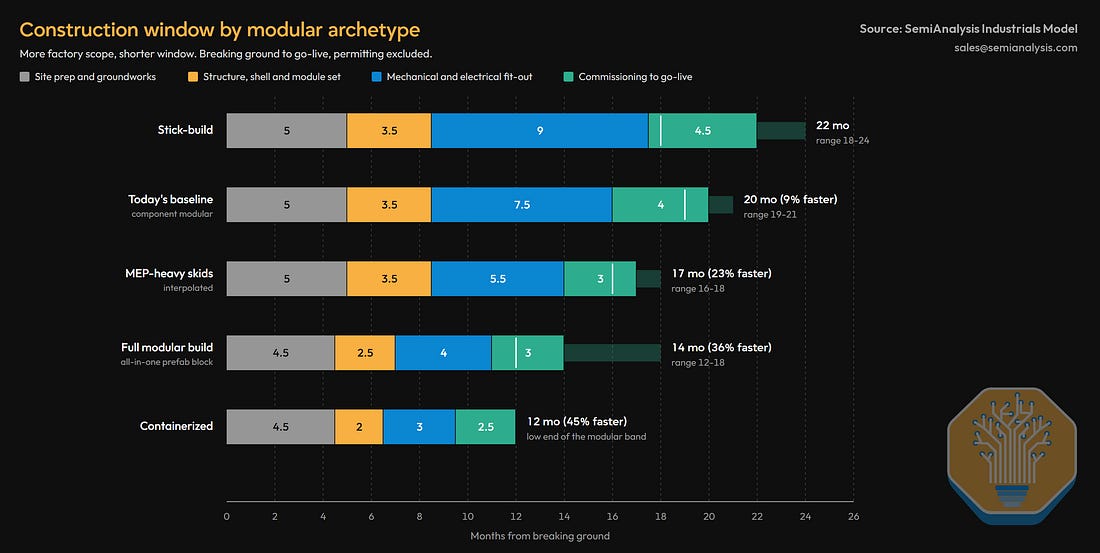
In this deep dive we rebuilt the modular case bottom-up against some of the speed and cost claims made by vendors like Vertiv or Schneider, finding that modular construction can compress the construction window by ~36%, or 7-9 months, and is ~8% cheaper on a Capex/MW basis. We also analyze how vendors like Vertiv are able to expand their value capture per project by offering the full stack solution, going from their historical ~$3.5M/MW content to ~$7M/MW with the modular solutions.
The problem, though, is that today everything seems to be modular and vendors, EPCs and Colocation providers many cases are describing entirely different things. To bring some order to this wild west, this article unpacks what modular actually means. We map the vendor landscape building a modular universe of more than 80 players and test whether the vendor claims hold up.
For subscribers, we focus on the main beneficiaries and break down how each player is positioned, from the public names (FIX, STRL, PWR, VRT, SU, FLEX…) to private challengers such as Infra Partners, Bladeroom, and Faith Technologies, distilling the key insights from our recent Core Research subscriber notes on Comfort Systems: “Modular Capex Is The Moat” and Sterling Infrastructure: “Winning Where It Counts: Quadrupled TAM via Texas, Pacific Northwest, and the Midwest; 2X Content per MW from CEC Attach; ~$6B Run-Rate In View”.
To start off, we’d like to thank QTS, EdgeConneX, Aligned Data Centers, Schneider Electric, Applied Digital, DG Matrix, Aran Industries, Karman Industries, Radiant, and Rajat Bhagat for their contributions and insights during the preparation of this deep dive.
Before we go into the detail taxonomy, let’s start with the basic definitions, because two words concepts often get mixed up: prefabrication and modularization.
Prefabrication is the broader concept: any part of the build manufactured offsite and delivered ready to install. It is a statement about where the work happened, not about the shape of the thing.
Modular is narrower. It refers to the actual self-contained units (rooms, boxes, blocks) that ship complete and get bolted together on site. Every modular unit is prefabricated, but prefabrication may not be directly modular.
Hold onto that distinction, because it is the spine of everything below. From here on, we will walk through the landscape the way a datacenter is actually built up, then we will go into details on the taxonomy that makes up the modular market starting from the ground up.
At a high level, a datacenter can be seen as simple three stacks of layers: Site, Shell, and Systems.
At the bottom we have the site, or the physical land of the datacenter buildout. This is where grading, wiring, and foundation building take place. This layer cannot be modularized because you have to physically break ground on a parcel of land and pour foundations into it on the set up.
Above that sits the shell, which means the structure, skin, and roof that serve as the backbone and weatherproof the entire datacenter buildout. Inside the shell is where all the equipment and subsystem, including all the mechanical and electrical systems, sit.
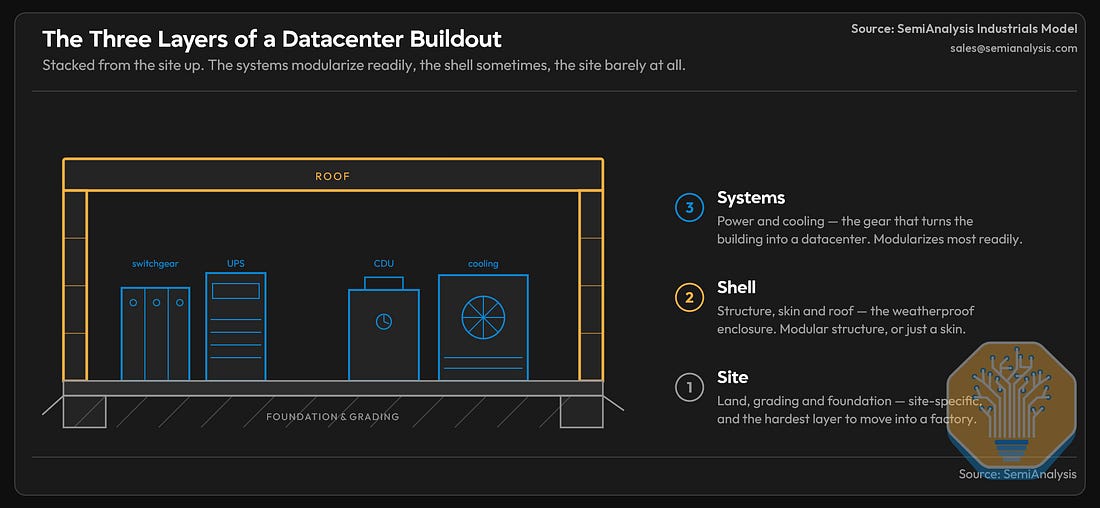
Considering that the site itself can not physically be moved, prefabrication strategies are focused on the other two layers, and we take them in that order, working from the outside in.
The shell is the structure, walls, and roof that hold the datacenter up and keep the weather out. It generally follows either a frame-and-skin design, where the structure and cladding are separate, or a load-bearing panel design that combines both.
In a traditional build, both the skin and the frame need to go up on site. Crews break ground, pour the foundation, then form and cure concrete right where the building stands, one piece at a time. A modular shell starts the same way, on a poured foundation, but from there the structure and panels arrive as finished pieces from a factory, craned and bolted into position once arrived.
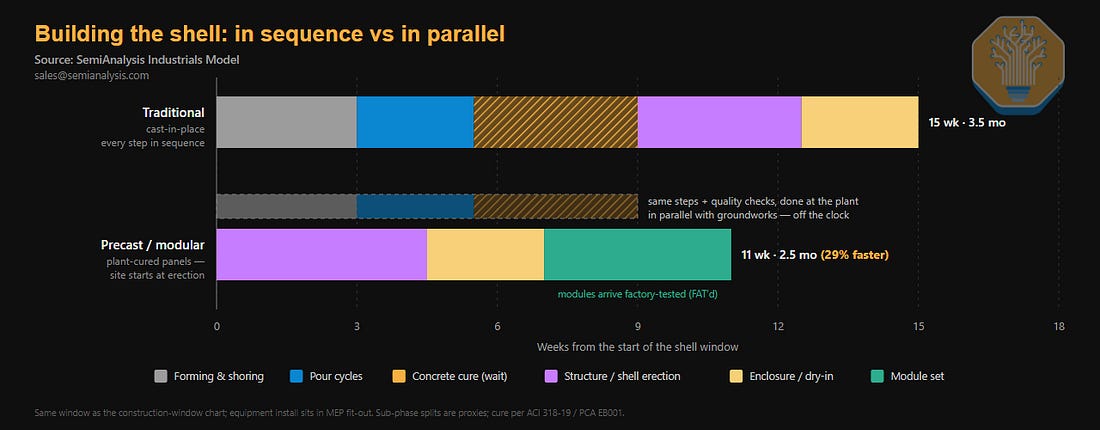
The time saving is evident from the graphic above. In the traditional cast-in-place buildout, each pour has to reach roughly 75% of its design strength before the next can go on top. Prefabricated structure sidesteps that wait.
However, the evolution did not stop with prefabricating the same conventional building. The larger gains now come from simplifying the building itself: moving from complex multistory facilities toward repeatable single-story halls, and then toward narrower, purpose-built structures.
The first phase is precast concrete described above. Instead of forming and curing the full structure in the field, panels are manufactured under controlled conditions, transported to the site, and craned onto a prepared foundation.
This is not new. Northern Virginia has used precast extensively for years because construction labor was already constrained. CloudHQ’s two-story LC-2 facility in Ashburn is a representative example: its load-bearing shell supports long, column-free spans and enough structural load to place mechanical equipment on the roof.
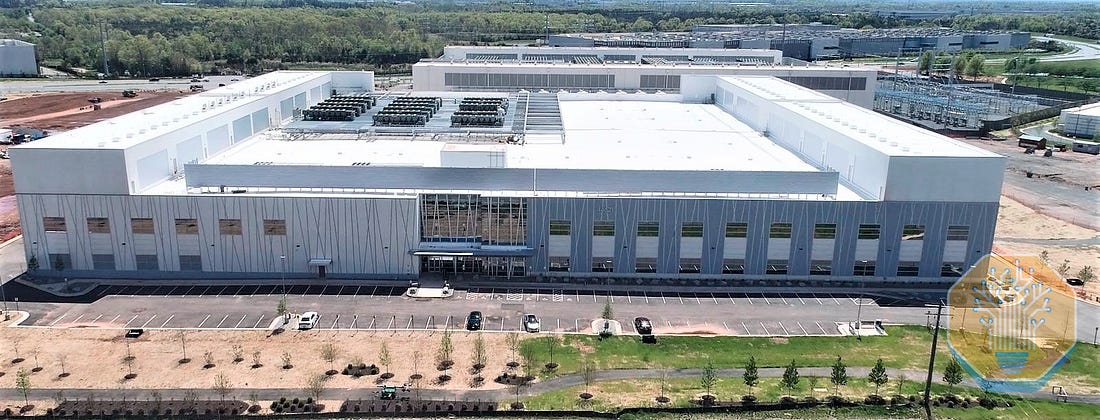
Nevertheless, the building still took roughly 18 to 20 months to deliver. Precast reduced field forming and curing, yet the underlying facility remained a large, multistory structure facility.
Tilt-up concrete follows a similar logic but casts the panels on the building slab rather than in a remote factory.
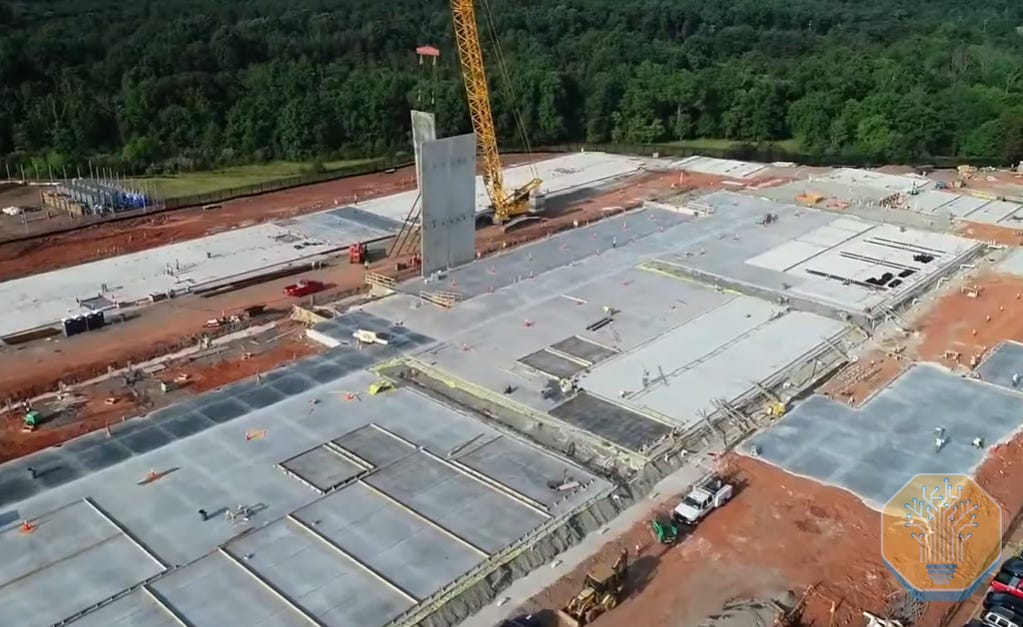
This method avoids long-haul transportation and can be the lowest-cost route for a large single-story box, although quality and schedule remain more exposed to site conditions and weather.
The second phase is where design changes happen. In order to further speed up the time, the industry turn towards alternating the design for simplicity. These buildings use regular structural bays, fewer architectural features, and standardized exterior panels. Steel is often favored because the frame can be fabricated off site, shipped efficiently, and bolted together quickly across a large flat campus.
At the light end is the pre-engineered metal building, or PEMB built in three parts:
The primary frame serving as the structural skeleton
The secondary frame tying the main frames together, these are lighter steel member like roof purlins that span between the primary frames.
The skin, keep in mind this is different from the frame. They are the thin light weighted metal panel whose job is to protect the interior from extreme weather conditions
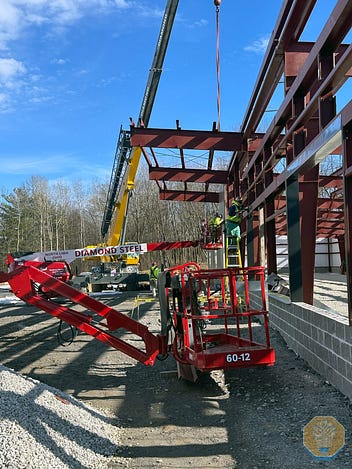
This is the fastest option since all parts arrive cut, punched, and labeled, a crew simply need to bolt them together on the site. Furthermore, a light steel structure needs far less material than concrete.
More demanding halls use structural steel - heavier, hot-rolled beams and columns fabricated off site and bolted into a rigid frame. It costs more than a light PEMB but supports wider spans, heavier loads, and more complex layouts.
QTS’s Cedar Rapids campus shows the speed and scale this approach can unlock. The current 420 MW phase spans approximately 2.8 million square feet and uses roughly 28,000 tons of structural steel. QTS moved from groundbreaking to topping out in about five months, with the broader building delivered in approximately 11 months.
The exterior is then closed with prefabricated cladding, most commonly insulated metal panels. Similarly, we see this approach with Crusoe’s Stargate campus in Abilene, each building used roughly 672 factory-made panels. The panels were fabricated in under 40 days and installed at approximately 15 to 20 per day, helping bring each building to a dried-in shell in under eight weeks.
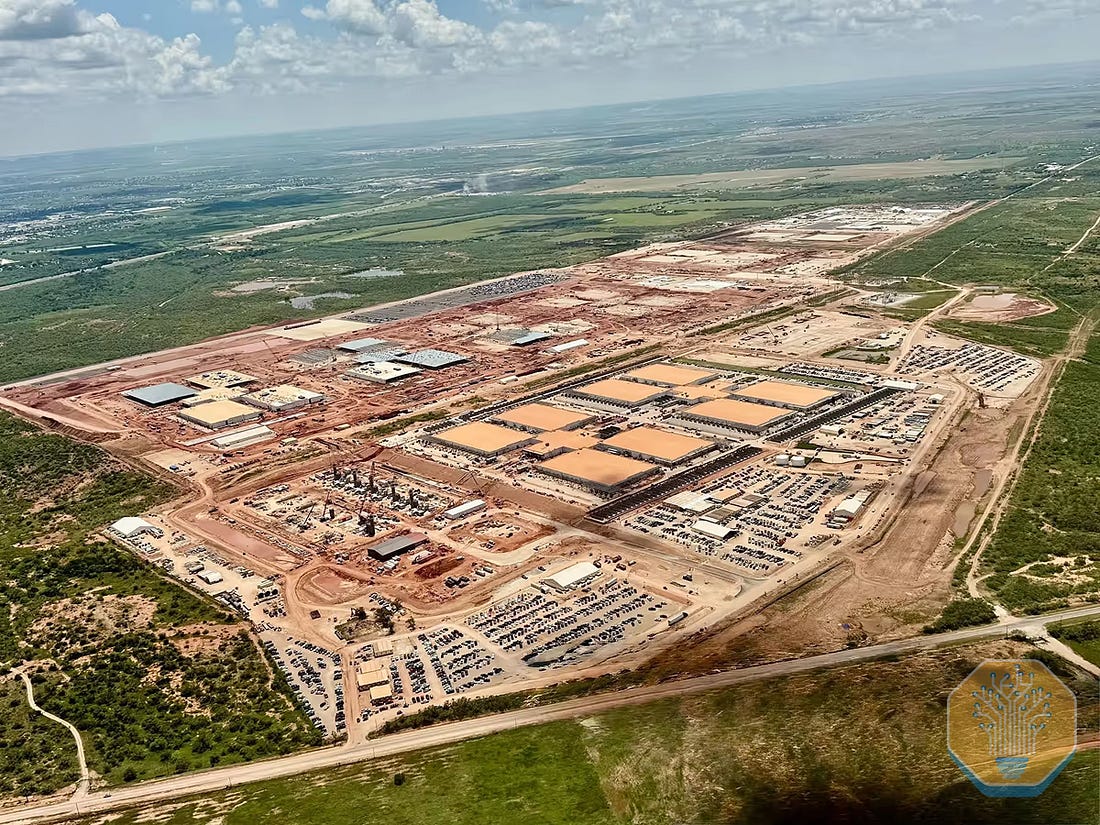
The speed advantage therefore comes less from steel itself than from what it enables: simple single-story halls, repeatable structural bays, fewer field interfaces, and a supply chain that can be reproduced across markets. It can also reduce labor and structural material per MW compared with a dense multistory design.
The main trade-off is land. Single-story campuses require more acreage, but that is often acceptable in newer AI markets where land is cheaper and deployment speed matters more than maximizing MW per acre.
The third phase pushes simplification further by designing the enclosure around a more specific deployment model. Narrower, lighter structures can reduce the amount of conventional shell work and support faster repetition, although tighter optimization may leave less flexibility for future equipment or layout changes.
Meta’s rapid-deployment structures at Prometheus campus in New Albany are the most visible extreme. The aluminum-framed, fabric-clad halls provide enclosure and weather protection without constructing a conventional permanent shell. Each structure is roughly 125,000 square feet, and satellite tracking showed eight standing by April 2026 after the buildout was announced in July 2025.
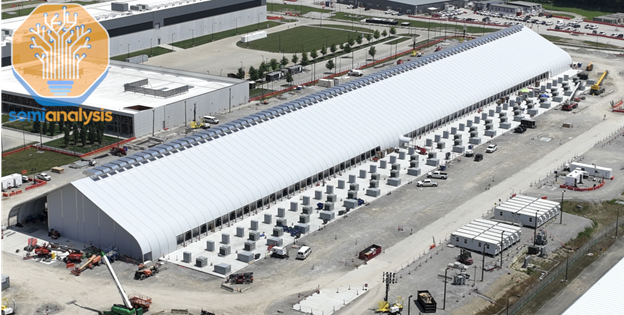
That does not mean Meta completed a full datacenter in nine months. The tents accelerate the enclosure, not utility interconnection, power, cooling, or commissioning. They also trade away some of the durability and long-term flexibility of a permanent concrete or steel building.
AWS is moving in a similar direction with its newest modular builds. Rather than treating the shell as a large generic warehouse, AWS is using narrower and more repeatable structures organized around the systems installed inside. The result is less building per MW, shorter structural spans, and fewer interfaces for field crews to assemble.
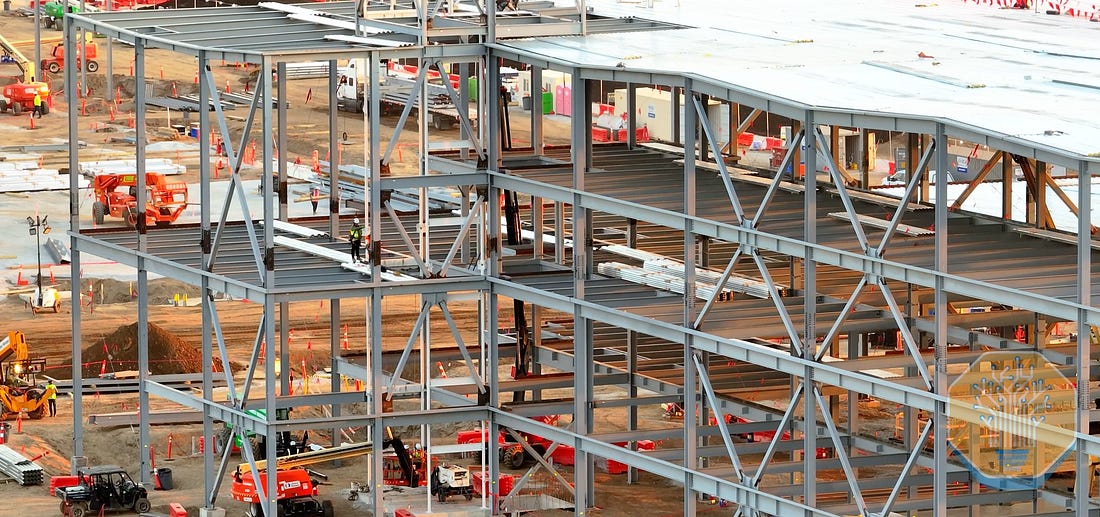
The common thread is that shell modularity is increasingly about design simplification, not just prefabrication. Precast moved concrete production off site but largely preserved the conventional building. Standardized steel made single-story halls easier to repeat across markets. Purpose-built structures go further by reducing the size and complexity of the shell itself.
The cost savings thus come from removing floors, reducing structural complexity, decreasing labor on site, and repeating the same enclosure / supply chain across the campus. Once the shell is dried in, the larger modularization opportunity moves inside, to the power, cooling, and white-space systems that turn the enclosure into an operating datacenter.
Equipment and subsystems are where most of the real modularization is happening, and the offerings span an enormous range, from a single piece of equipment all the way up to an entire building delivered ready to switch on. Previous deep dives already covered in big depth the anatomy of Mechanical and Electrical systems. Besides, before we start naming categories, it helps to fix some vocabularies:
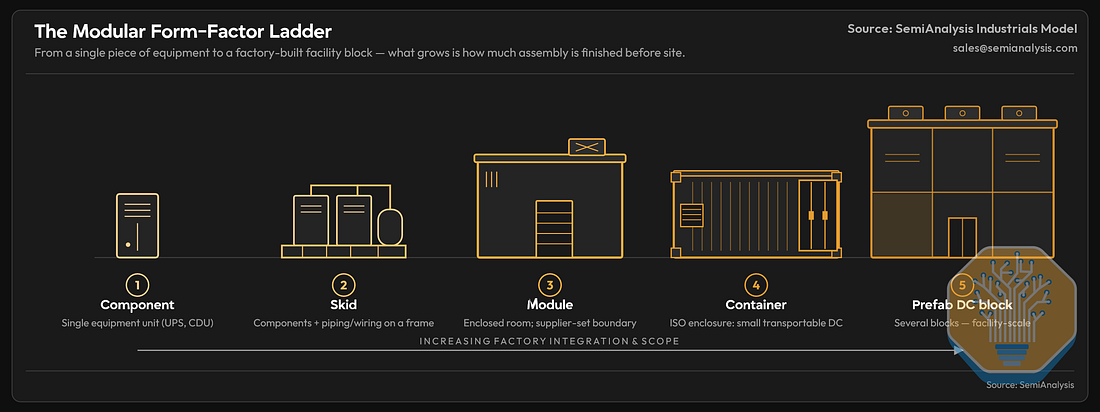
Component: The lowest level of form factor. It is a single piece of equipment manufactured in a factory.
Skid: First common modular form. It is a group of components mounted on an open frame. Instead of shipping each piece separately, the equipment is pre-arranged, configured, and shipped together as one package.
Module: A skid but in an enclosed space. It can go anywhere from a simple power room to a prefab mechanical/electrical room similar to a skid, but only it will become a module if you put walls and roof on top of it.
Container: A specific form of module using ISO container for packaging. An ISO container is built specifically for standard shipping dimension, which means it can travel anywhere on normal transport with a truck without limitation.
Prefab Datacenter block: Facility scale buildout that stitches multiple factory-built module into a much larger facility block. The intent of these block is to serve as an end-to-end datacenter buildout
This is like a ladder, from 1-5 increasingly factory integration and scope. If you look carefully, you may also be able to realize the first 4 levels are better known as the subsystem modularization. This is where the supplier delivers one part of the datacenter as a factory-built unit. That unit is arrived assembled and tested, but still has to be connected into the broader facility before it becomes useful.
The last level and sometimes the fourth level, moves closer to a whole facility modularization. Here, the supplier is delivering a much larger portion of datacenter as an integrated product.
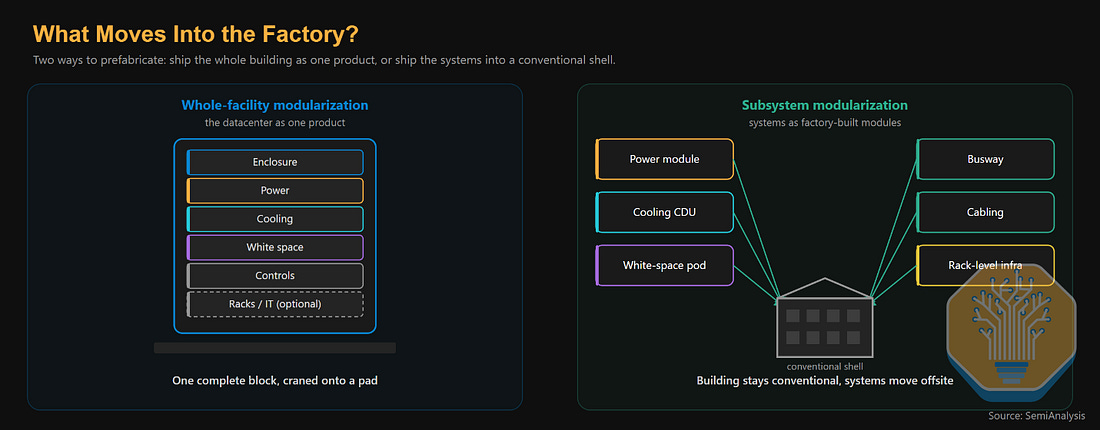
With the vocabulary in hand, we can now start climbing the ladder, and the natural place to begin is at the bottom, with subsystem modularization. This is the larger of the two families and where most of the market lives today. We start off with the grey space, and modular power block is where most people think of when discussing modular design.
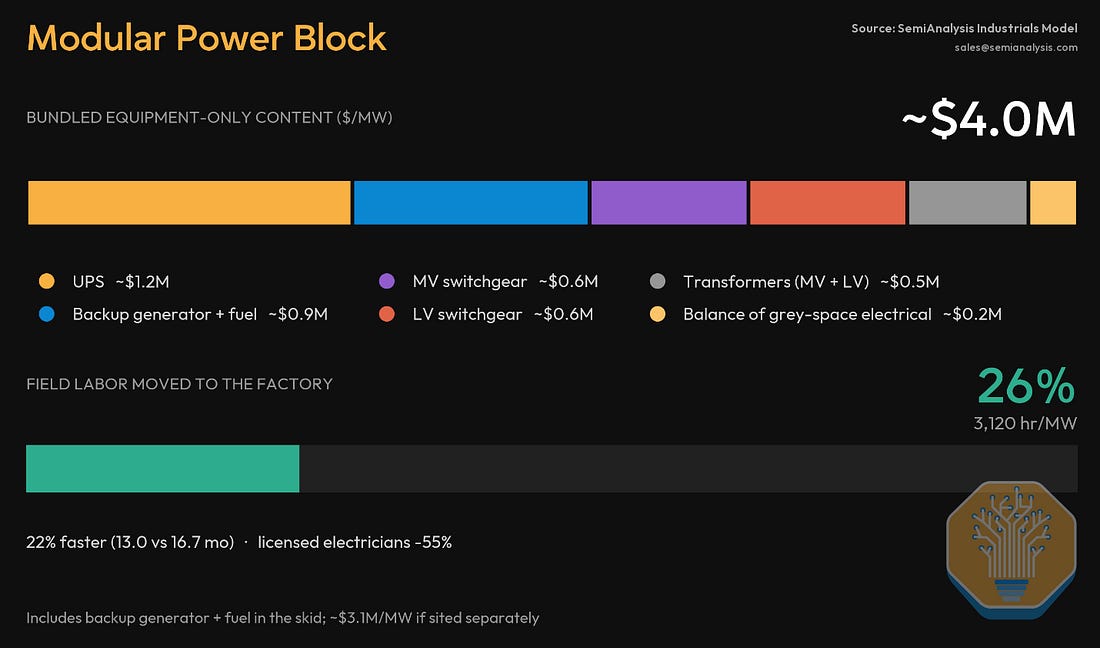
A power module is a factory-built electrical room or power block that packages the major electrical equipment into a containerized box. Among all subsystem modules, power is one of the most natural areas to modularized because the equipment lineup is well defined and lots of different pieces are needed to assemble the units. The electrical fit-out and commissioning take on average 5.5 - 16.7 months on a 50MW power hall.
To illustrate with an example, let’s see Flex’s modular power solution, built through the Anord Mardix unit below:
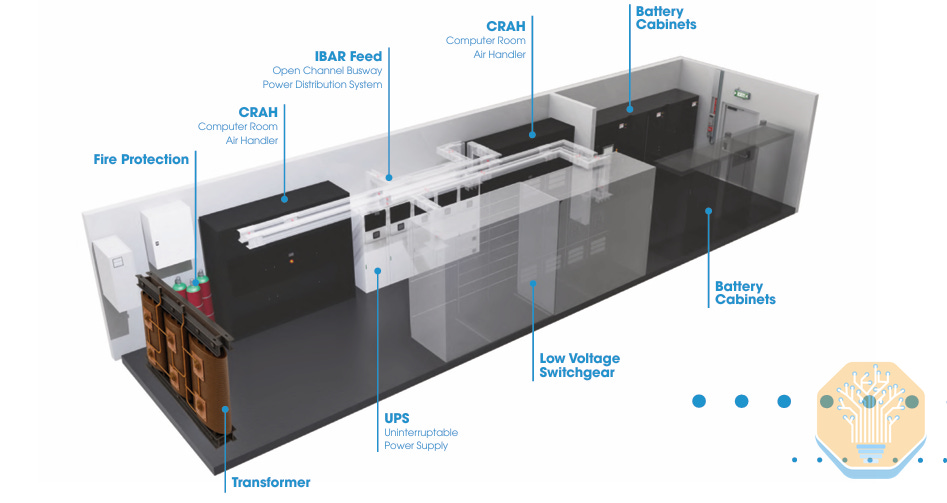
Flex sells this in two versions, the power skid and the power module pod, which is the same lineup wrapped in a secure enclosure. Inside the room, you will find major electrical components laid out like a power train.
As you may have noticed, the module also contains the busway system like the IBAR feed above the building which bridges the power pod to the data hall. The CRAH units, or computer room air handler and fire protection system, also exist to help manage the air temperature inside the enclosed shell and protection against unexpected conditions.
By our own estimate, the power block is where the schedule payoff concentrates. Moving just the power scope into the factory, roughly ~26% of the build by content, gets a hall to IT-ready ~22% faster, ~13 months against ~16.7 for stick-build, and around ~5% cheaper per MW, largely by compressing the mechanical-and-electrical fit-out from ~5.5 months to ~2.5.
Lastly, within modular power blocks, a new subcategory is emerging, which we can define as “software defined” power routing blocks. Instead of packaging the conventional transformer+switchgear+UPS+battery chain into a box, companies like DG Matrix replace portions of that chain with power-electronics-based multi-port routing. These systems can connect grid, generation, storage, and DC loads through a common controlled power platform.
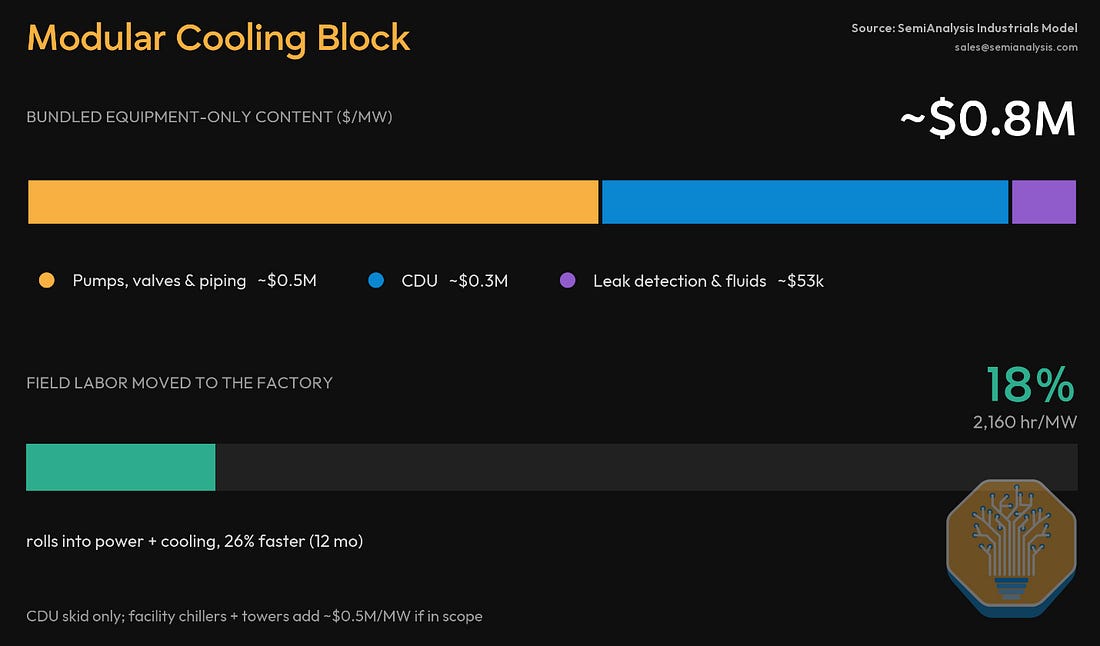
Similar to a power module, the cooling block packages the datacenter’s cooling loop into one integrated subsystem. At first glance, the case for modularizing cooling is weaker than for power, since there are simply fewer pieces to pre-assemble. But as primary and secondary loops grow more complex, the ability to add cooling capacity in repeatable, modular increments becomes far more attractive to operators.
Focusing on the TCS loop, the majority of modular efforts are centered on skids for CDUs. Airedale by Modine’s skid-based CDU (for more on cooling systems, read our Cooling deep dive here) is an example of this category.
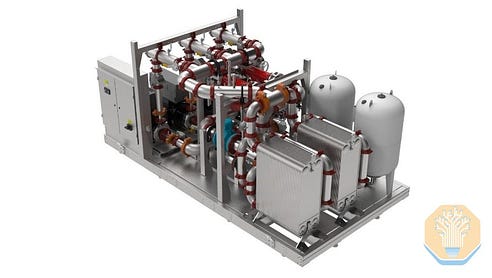
The Airedale by Modine skid-based CDU is a 2 MW-class unit arrives on a pre-manufactured skid with everything included, from the red-and-silver cooling loop to the buffer tanks on the top right, and even the leak detection system built into the end of the skid. On site, all the crew needs to do is hook up the two loop connections and a power feed.
On the other hand, the value proposition for prefabricated cooling systems is stronger when looking at the secondary loop and the outdoor mechanical yard, where piping and other outdoor cooling infrastructure is prefabricated, significantly reducing the civil, piping, and controls work completed onsite.
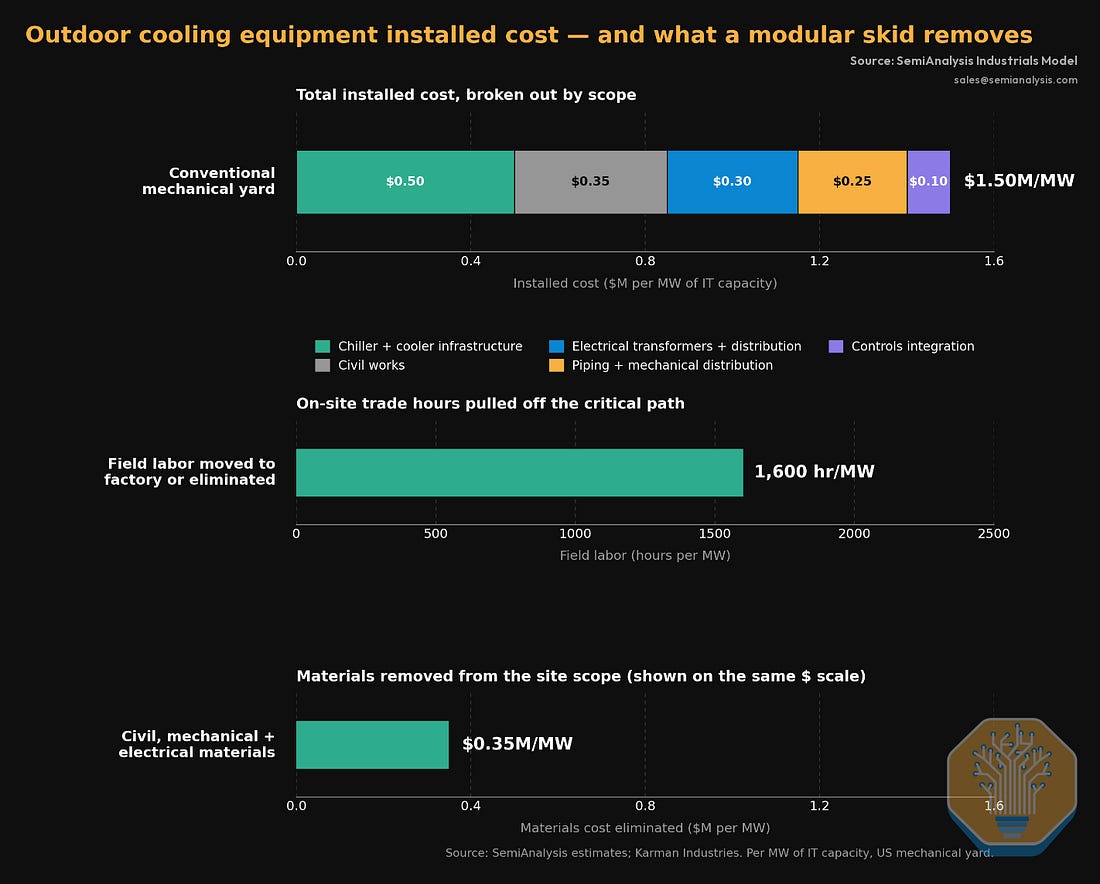
When thinking about cooling equipment, keep in mind that much of it was originally designed for hospitals, campuses, and industrial process cooling rather than GW-scale datacenters. At that scale, large footprints and hundreds of co-located units can create issues such as hot-air recirculation and heat islanding.
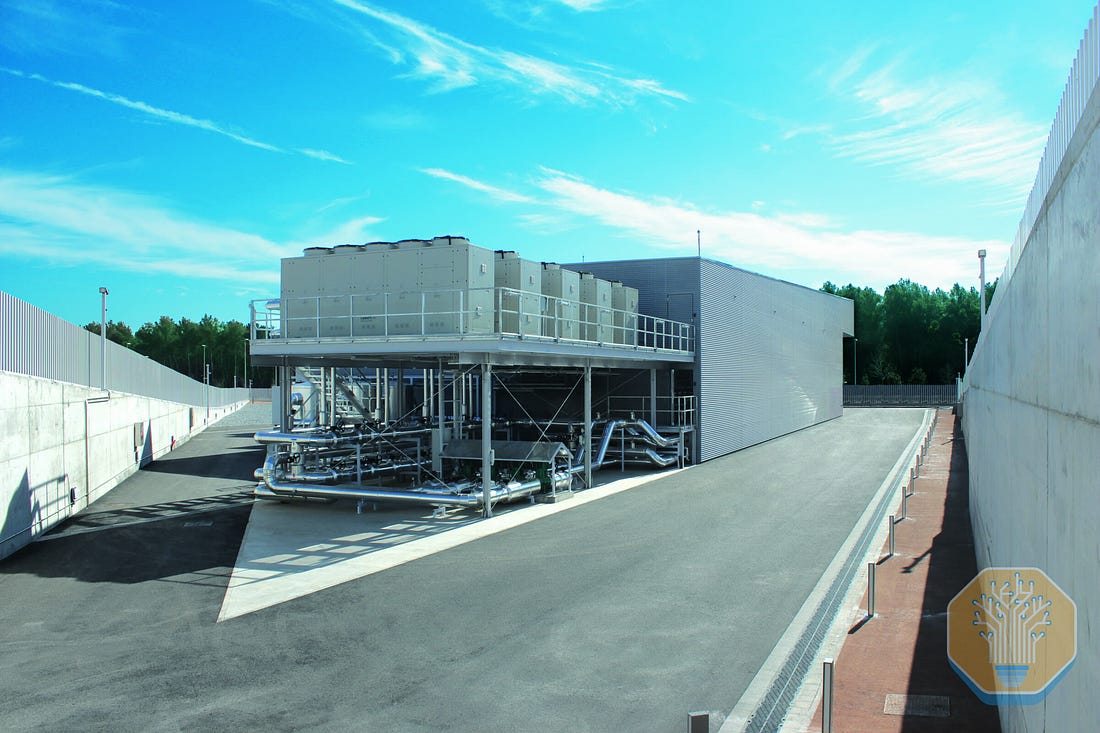
The Vertiv installation above shows a conventional mechanical yard. The cooling plant sits outside the data hall as a separate piece of infrastructure, with chillers, pumps, piping, and supporting steel assembled around the building.
Some datacenter developers, like QTS, are now prefabricating most of the piping infrastructure, which allows for faster installation while maintaining high quality. That becomes especially valuable today, given the increasing piping requirements of dense liquid-cooled deployments.
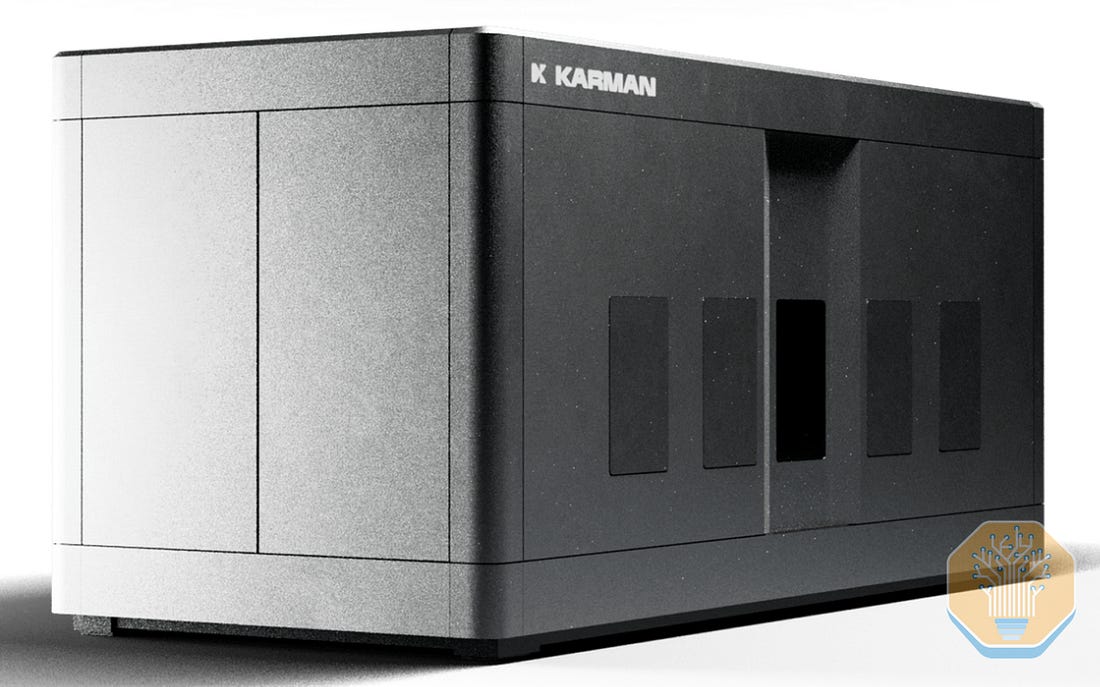
A handful of new entrants are now even attacking the whole yard. Karman Industries’ CO2-based Heat Processing Unit (HPU) is a purpose-built unit borrowing SiC power electronics and permanent-magnet motors from EVs, and compact turbomachinery and advanced heat exchangers from aerospace. The HPU, which is configurable to each site, ships as an outdoor-rated NEMA skid at 4 to 5 times conventional power density and cuts yard footprint by 60 to 80%.
Power and cooling are not the only parts of the datacenter that can be move into the factory. The same concept can be apply across the gray space such has the energy storage (BESS) system, water treatment skids, Fire safety system, and many more.
Many are not on the critical path for construction timeline, or they are small enough to be able to build on site. Moreover, where these systems do get modularized, they often ride along inside a large unit rather than shipping separately. For example, the Schneider EcoStruxure for example was built in with the fire protection system.
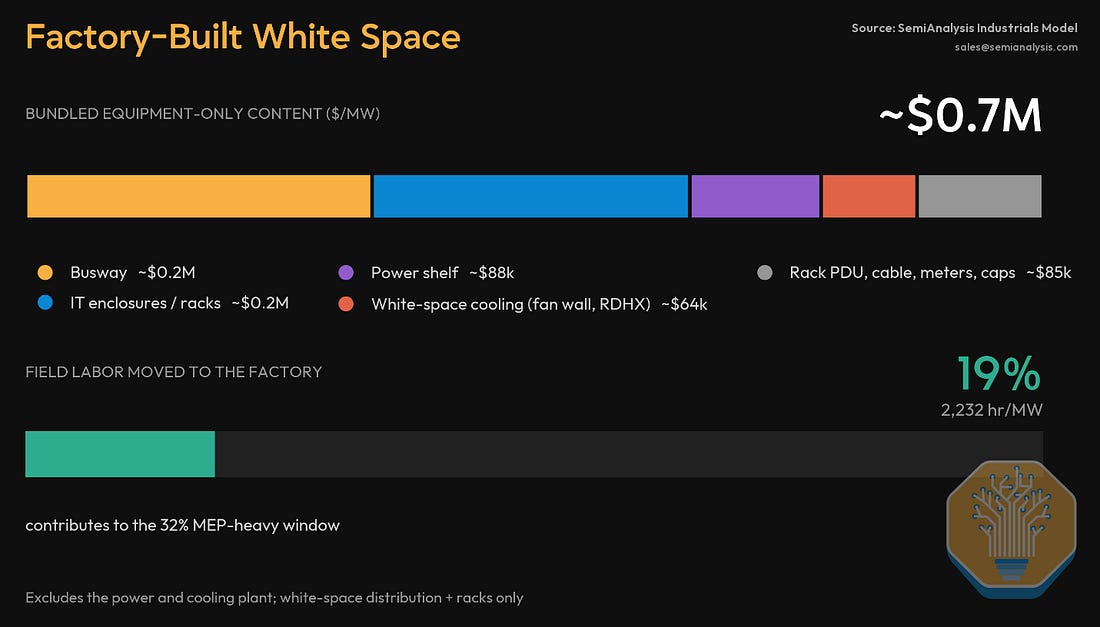
The intention of the factory built white space module is to replace hand-built data hall and manual on-site wiring with a unit made factory product. This means operator can directly put compute in place without the need to figure out wiring and connection.
The whole package comes ready for the rack frames, and all the last mile connection points the rack need to operate. Think of it like a prepared envelope for compute, its organized where racks go, provide the cable and connection to how they receive power and extract heat, and include prefabricated power busway and technical water loop situated above the rack.

Take Schneider’s EcoStruxure Pod as an example. The image above shows the black cabinets forming the IT rack rows where products like Nvidia GPU servers would be installed, a total of up to 40 racks can be placed in this one system. Above the racks, the gray overhead infrastructure is the distribution layer. It carries the busway that delivers power to each rack, containment to capture hot air as some of the solution will still be air cooled, technical water loop to distribute liquid cooling that extracts heat, and cabling that connects each servers.
The interesting thing about this is the product design behind it. A factory white space must be able to serve different custom needs and therefore, suppliers like Schneider work with Nvidia to support more than 30+ reference designs. The buyer can essentially pick the specs that matches the chips it wants and gets a hall that is pre-coordinated with the matching required power and cooling module. In the coming section we will study in more detail how the design process takes place.
Whole Facility modularization is the literal datacenter-in-a-box model. Instead of delivering individual parts, the supplier delivers a complete or near-complete datacenter block.
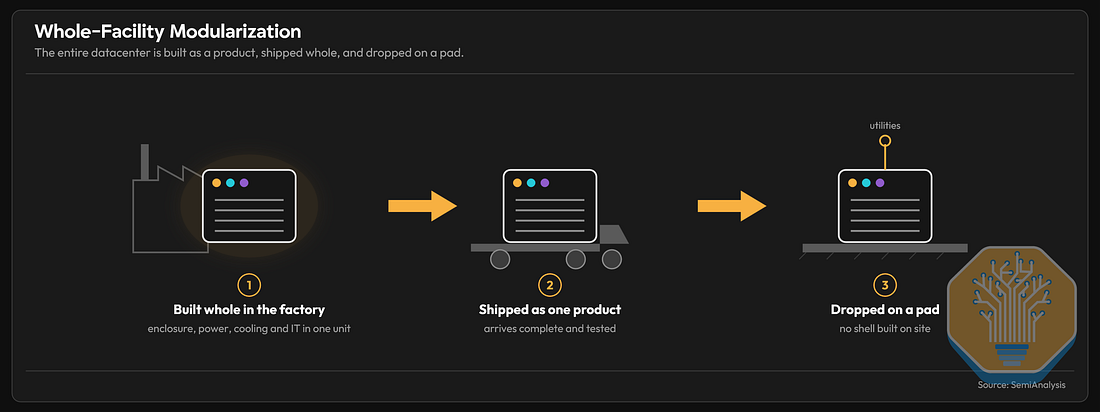
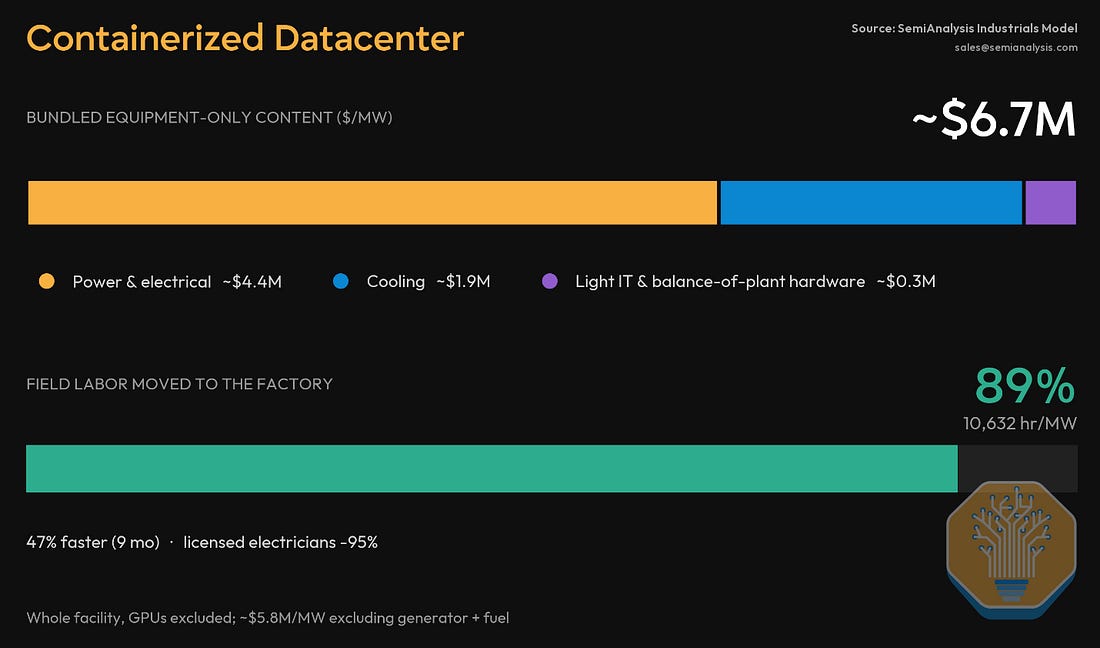
Starting with a containerized datacenters, this is the 4th part of the form factor design where the datacenter itself is packaged into an ISO-style container or purpose-built weatherproof enclosure. Like we had discussed, the reason why this option exist is for the ease of transportation.
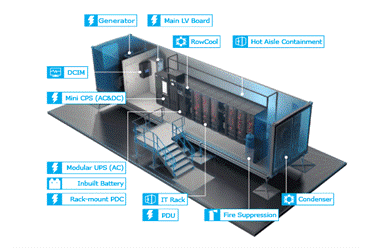
As the image shown above, you can see almost everything inside the box: the IT racks, the power equipment, the batteries, and even the cooling system.
These types of design are commonly used in edge computing, industrial environments, remote or unused spaces, and the product is most useful when the buyer needs a smaller datacenter quickly. For AI workloads, the buyer is usually not a compute startup chasing scale but an asset owner that needs low-latency inference at a fixed physical location.
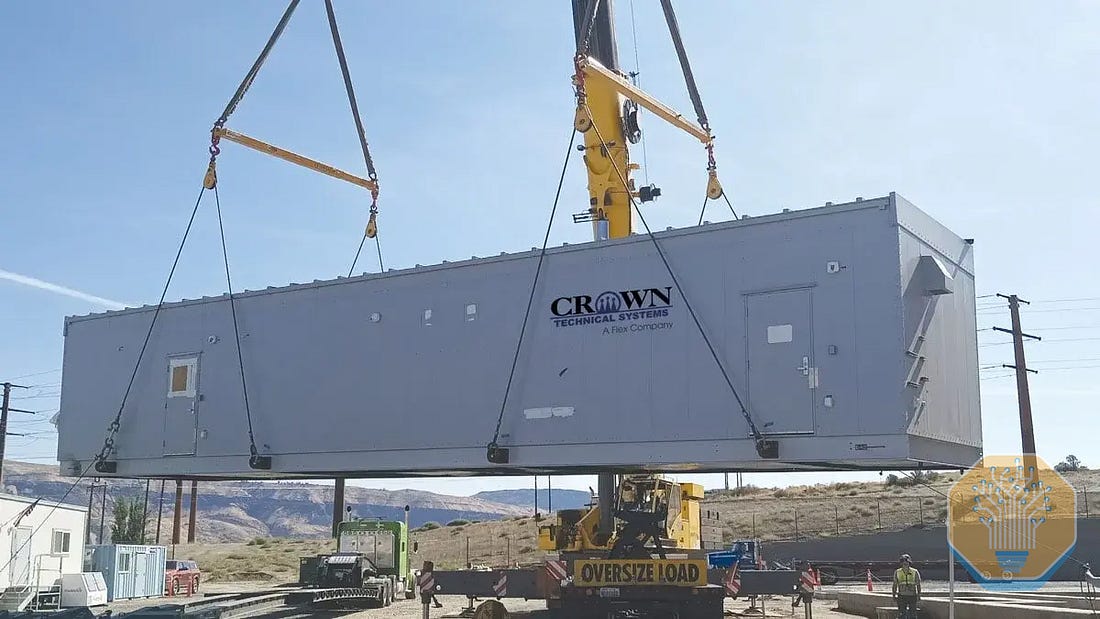
The main limitation of this buildout is density. The same form factor that makes the unit portable and fast to deploy also fixes the layout. That’s why suppliers are pushing beyond the containerized model toward all-in-one prefab datacenter blocks.
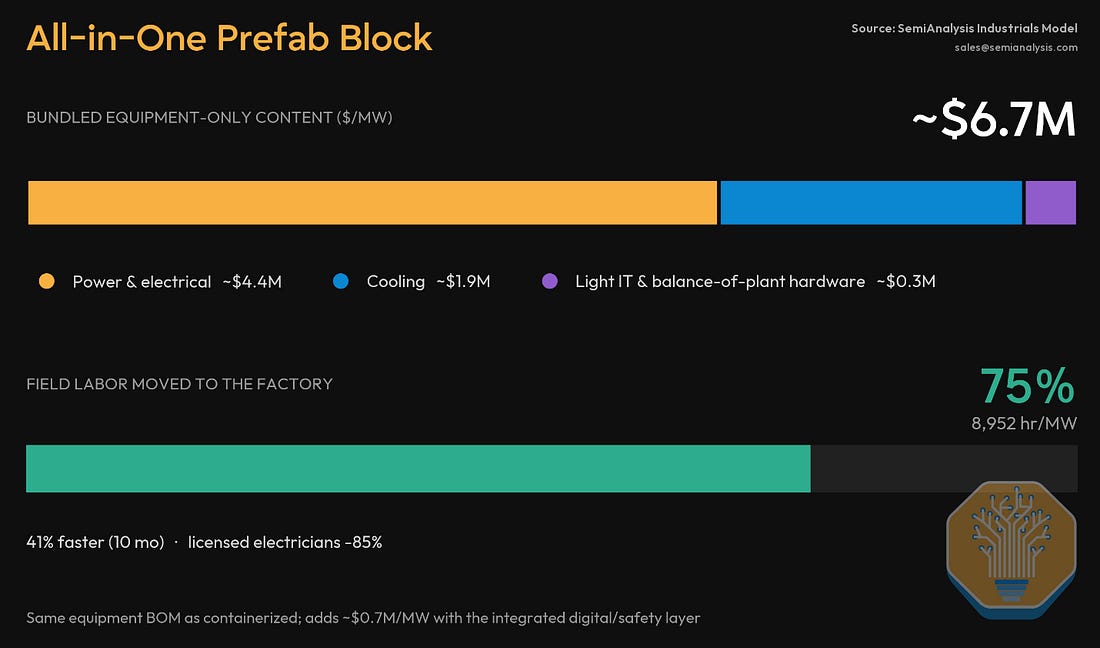
The all-in-one prefab datacenter block is the more ambitious version of whole-facility modularization. Here the supplier delivers a larger facility block with more of the datacenter already integrated before delivery.
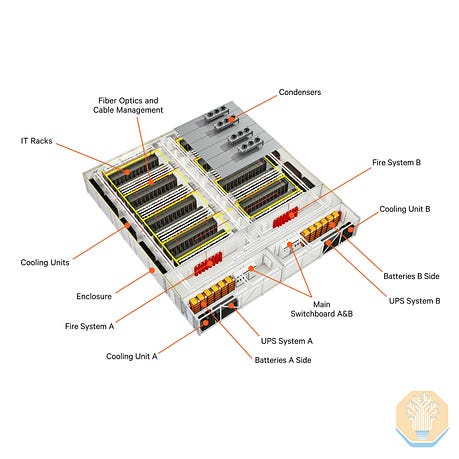
Vertiv MegaMod shows what this can looks like in practice. The structure effectively is a modular datacenter with the major systems packaged into one enclosure. The center of the block contains the IT racks, where servers are installed. Above and around the racks runs the fiber optics and cable-management pathways, along the perimeter are all the supporting infrastructure systems like cooling and power units.
The system’s 1 MW reference design can stretch to approximately 26.5 meters long, 24 meters wide, and 4 meters high in dimensions. While the MegaMod plus version can extend to as much as 31 meters wide. You may be wondering, if it’s this big how can it be ship to the site? In reality, the structure needs to be broken into transportable prefabricated sections, shipped through a standard heavy-haul logistics truck, and then connected and commissioned as one.
The last step in whole-facility modularization moves beyond any single vendor’s block into a standardized reference design for the facility itself. In the same fashion the industry has reference designs for rack systems and CDUs, Nvidia now publishes one for the entire AI factory: Nvidia DSX. It was first unveiled as an Omniverse digital-twin blueprint at GTC Washington in October 2025, formalized as the Vera Rubin DSX reference design in March 2026, and more recently expanded into the full DSX platform.
The DSX reference designs are validated AI factory architectures covering compute, networking, storage, hardware cluster design, and also the facilities side, including power, cooling and controls. Even civil, structural, and architectural design. The value proposition behind is that Nvidia’s DSX Max-Q maximizes token per watt within a fixed power budget, and DSX Flex facilitates the connection the facility to grid services, dynamically adjusting power draw and orchestrating demand with hybrid onsite generation.
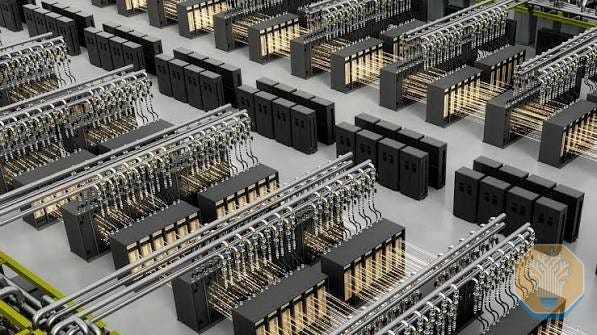
When deploying a DSX facility, through the Omniverse DSX Blueprint, an operator first builds a digital twin of the facility, simulates layouts, power topologies, thermal behavior, and operational policies in real time, and optimizes the design before construction begins, then reuses the same validated architecture across sites. For example, CoreWeave is already using DSX Air to build and test digital twins of its AI factories.
Besides, the whole DSX ecosystem includes pretty much all the supply chain: Cadence, Dassault Systemes, Eaton, Jacobs, Nscale, Phaidra, Procore, PTC, Schneider Electric, Siemens, Switch, Trane or Vertiv. Vertiv’s OneCore, for example, packages power and cooling into standardized 12.5 MW pods that can be combined into larger AI-factory deployments
EdgeConneX estimates that a common design can advance a project to roughly a 30% to 60% permit set before site-specific localization is complete, allowing substantial off-site work to begin earlier.
If you have made it this far, you should have a working feel for the categories. You should also, maybe be a little buried in names. We have put a power module from Flex, a CDU from Airedale, a data-hall pod from Schneider, and an all-in-one datacenter from Vertiv all in front of you. So before going further, it helps to step back and lay the whole market out on a single map.
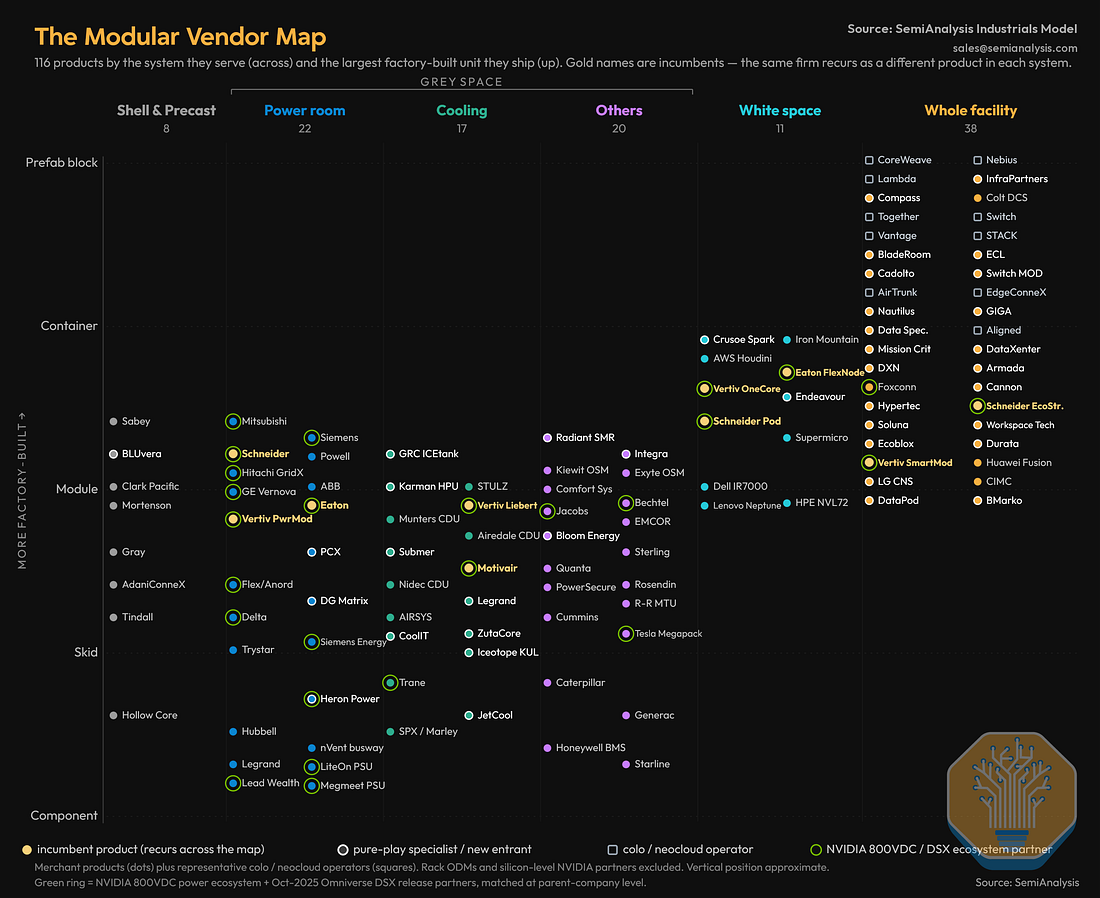
Our universe runs to over 80 players, and laying them out this way is useful because two patterns jump out right away.
The depth is in the subsystems. The power-room and cooling modular are by far the most crowded
The same names keep showing up across columns, because a vendor like Vertiv, Schneider, or Eaton sells a power module, a CDU, a white-space pod, and a whole block all at once.
The vendor landscape above maps who builds each piece, but not how those pieces become a module or who is on the hook when they do. From the solution provider’s point of view it has three answers:
At one end the operator holds both rights: it specifies the equipment, buys it directly, and hands it to an integrator purely for assembly.
In the middle sits the EPC- or integrator-led buildout, where the operator still sets the performance requirements but hires an EPC or integrator to source, coordinate, and build.
At the far end is the OEM-led model, where a vendor like Vertiv designs and sells its own stack as one finished product, as it does with the OneCore portfolio
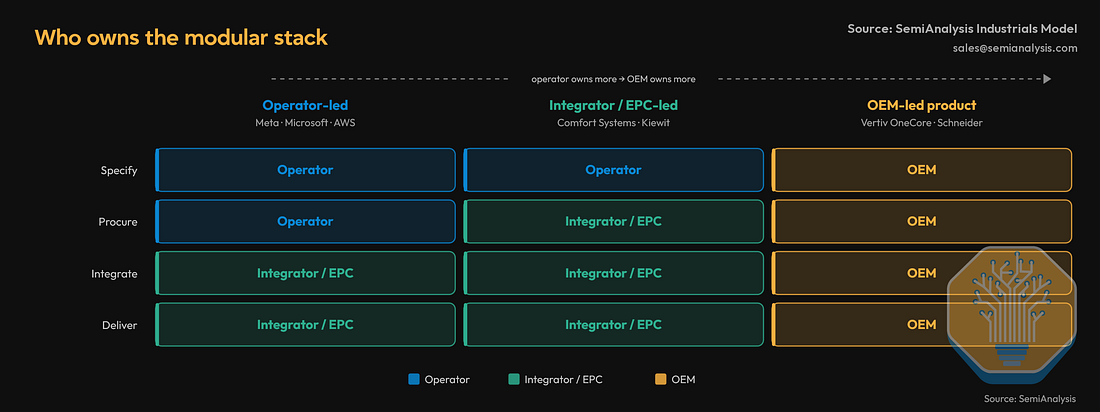
This is where the operator engineers the specification themself, procures the equipment directly as owner-furnished gear, and hands it to an integrator purely for assembly.
This model requires the operator to have a deep in-house engineering and procurement team to specify and source every component, and the willingness to carry all of the cost, inventory, and lead-time risk.
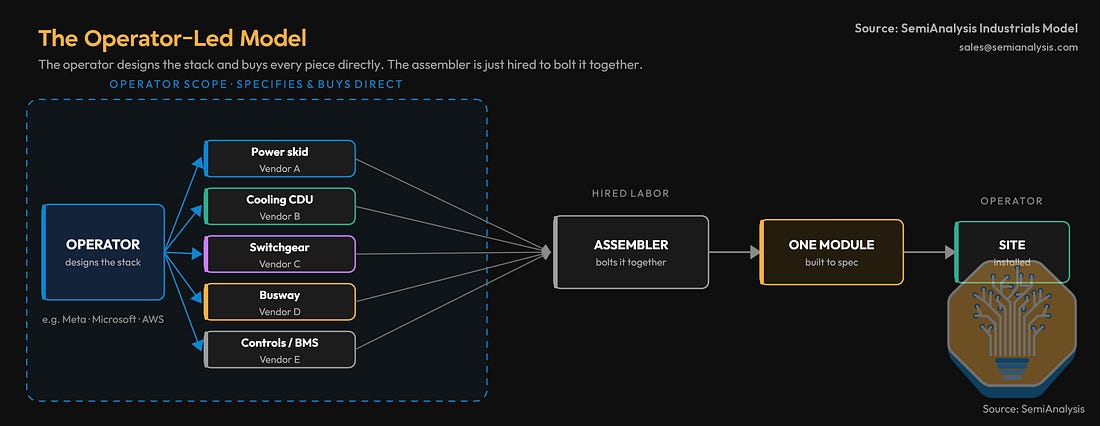
In a supply-constrained market that risk is sharp, since the operator is competing for scarce transformers and switchgear without a vendor’s allocation leverage, unless it buys at enough scale to have that leverage of its own.
That is why operator-led modular is effectively confined to the largest hyperscalers. AWS, for example, engineers its own prefabricated data-hall skids under Project Houdini and procures the equipment directly, using Cupertino Electric as design partner.
Aligned is another example of operator-led modularization, although it relies on external integration partners for manufacturing capacity. Aligned defines the architecture, owner-furnishes the major components, and controls the commissioning and quality program, while its integration partners receive, store, assemble, and test the equipment across multiple factory locations. The partner provides the production footprint, but the modular system remains Aligned’s design.
The EPC-led modularization includes system integrators or construction companies that take mostly third party equipment and convert it into a skid/module. The integrator does the assembly, installation, factory testing, enclosure, and is the party in charge of delivering the finished skid to the end customer.
The companies acting an integrators are both construction companies that have the footprint and capabilities to do the integration, like Comfort Systems, Sterling Infrastructure or Quanta’s Cupertino Electric, and specialized modular integrators, like PCX, Nautilus, DXN, Infra Partners, Bladeroom, etc.
This type of modularization is vendor agnostic, which means that the customer keeps more control over the datacenter design, while the contractor moves part of the construction sequence into a prefab shop. The EPC buys the equipment, assembles it, wires it, pipes it, tests it, and ships it as completed construction scope.
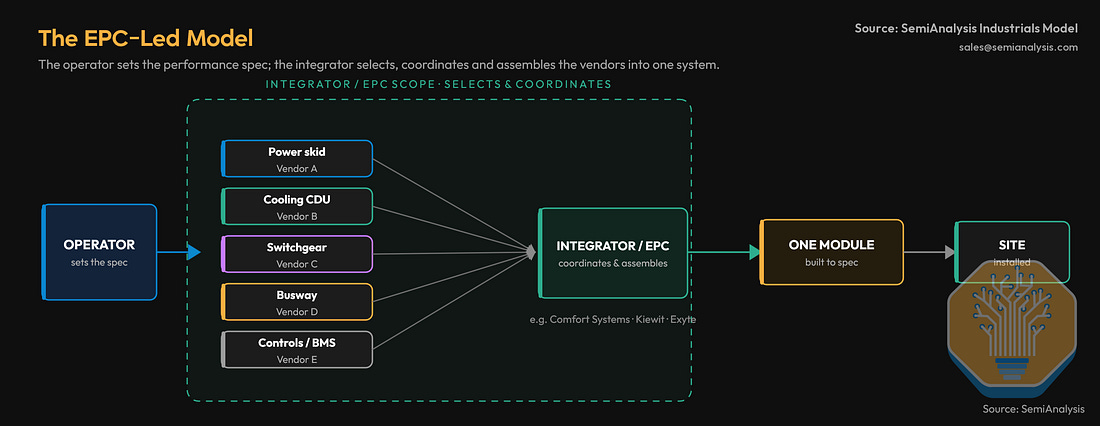
Take Comfort Systems as an example. It is a MEP contractor, not an equipment maker, so it acts as the layer that procures and assembles the gear on the operator’s behalf. The operator decides what equipment it wants and Comfort Systems does everything else. It runs that work through Environmental Air Systems and TAS Energy across 3.5+ million square feet of shop floor in Texas and North Carolina.
That concept is particularly attractive to hyperscalers. A big operator usually already knows exactly what equipment and design it wants, so it has no interest in buying someone else’s fixed system. Working with EPC integrators like the kind for Comfort System, the operator keeps its own design and its own gear, and simply hands the building of it to a factory instead of a jobsite.
Here the equipment vendor turns its own datacenter infrastructure stack into a repeatable module or platform. Although the product can still be configured for a specific site, the starting point is usually an off-the-shelf module using OEM’s own architecture.
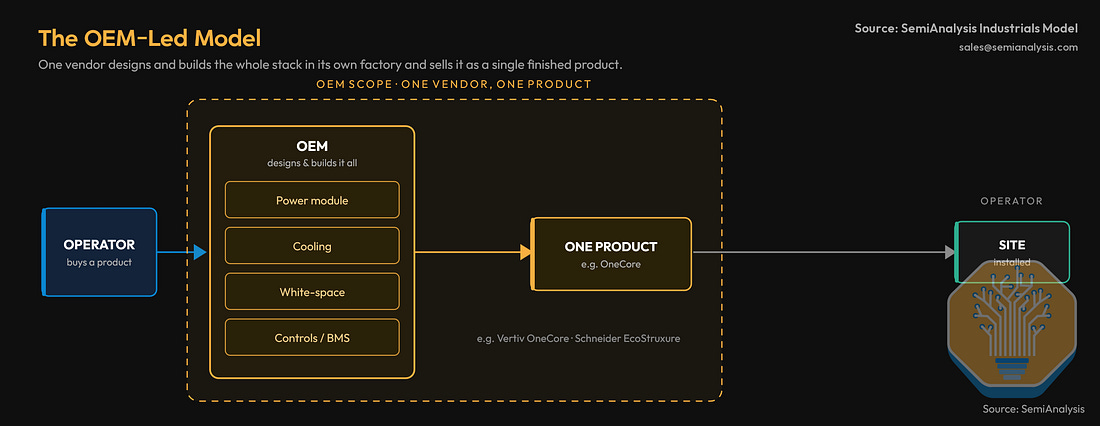
Vertiv OneCore is a clear example. Instead of selling single equipment devices, Vertiv combines all the layers into a single modular platform. This platform integrates Vertiv’s power, thermal, cooling, and IT infrastructure technologies inside a Vertiv’s supplied steel shell.
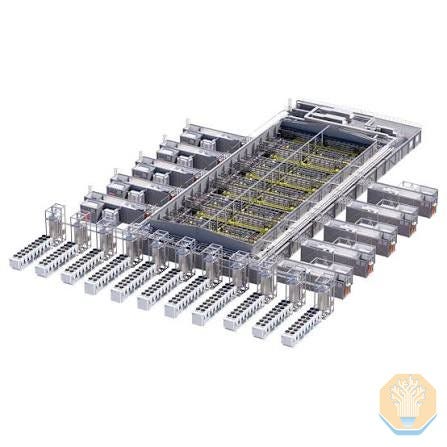
That is what makes it OEM-led, the customer is buying into Vertiv’s entire integrated stack rather than asking an EPC integrator to assemble equipment line ups. This also allows Vertiv to capture higher content by selling the entire stack end to end, with the TAM expanding up to ~$7M/MW for some of their full-stack solutions.
The tradeoff is capacity and execution risk. Besides the fact that these companies are going up the value-chain toward market segments they were not previously involved in, OEM-led modularization can only scale as fast as the OEM’s factory capacity, supplier base, and integration teams can support. Vertiv’s modular solutions run lead times of over 12 months today. This is also pushing big OEMs, not only Vertiv but also companies like Schneider and Siemens, to be selective with capacity slot allocation, requiring certain capacity minimums and favoring bigger projects. As a result, operators or developers looking for smaller scale capacity are increasingly working with the System Integrators.
By now our readers should be familiar with the different forms of modular solutions and the players leading this transformation. They will also have noticed how different this looks compared to traditional datacenter construction, and will have many questions about the operational implications. Those are the topics we address in this section.
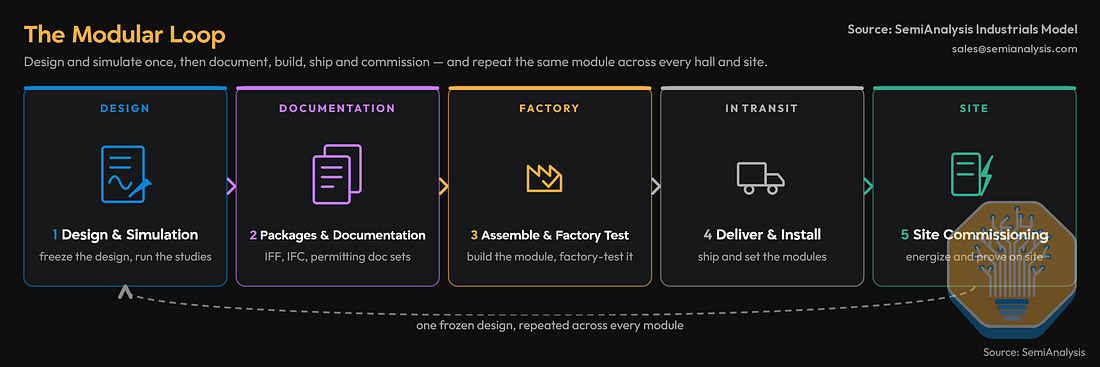
Engineering the solution is the first step. In a field build, some of these decisions can change while construction is underway. In a modular build however, they need to be predetermined, frozen early, and repeatable since the box itself must come in a finish block.
The most important engineering at this stage happens at the facility level. Before a module can be finalized, the design team must define the load, select the equipment, develop the single-line diagram (SLD) and layout, and complete the short-circuit, protection-coordination, and arc-flash studies in tools like ETAP and PSSE. These analyses determine how the system is sized and which components can be used. Because they depend on the full electrical path from the utility connection through the downstream equipment, they cannot be completed on an isolated skid. The facility design therefore has to come first, with the module designed as part of that broader system.
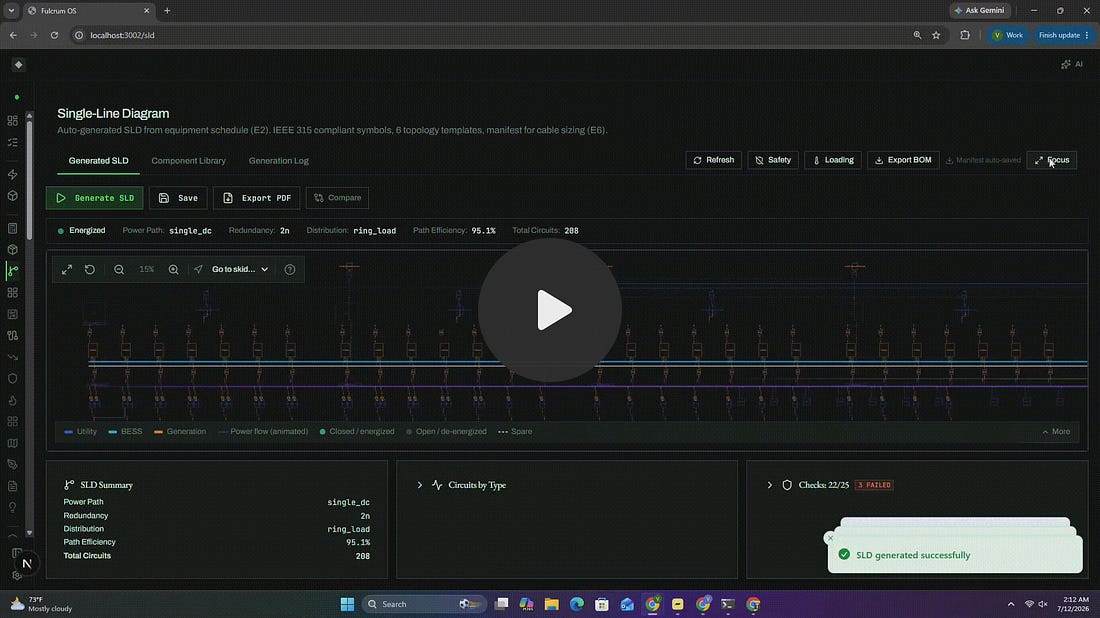
Source: Aran Industries
For 415/480VAC this work is well templated and repeatable. When considering all the implications of the 800VDC transition, it is not as well-templated. A handful of reference designs exist, but none are well baked yet, so the facility-level architecture is still being worked out design by design. This is also the part of the cycle now being automated. Companies like Aran Industries are building build custom software that plugs into ETAP, PSCAD, PSSE, Revit and the other design tools, compressing what is otherwise a multi-month (>2 months), multi-engineer electrical design process into hours of compute plus a single engineer reviewing the output.
Once the design is set, ownership comes down to two questions:
Who chooses the equipment;
Who carries the cost, the inventory, and the lead-time risk of the buildout.
Those decisions do not always sit with the same party. An operator may specify a component directly, or an integrator may select it and seek approval.
Colocation operators are a clean exception. A wholesale colo is not bound to any single end-user’s specification, and often does not even know who the tenant will be, so it is free to choose the equipment it wants and commit to it early, without waiting on anyone’s sign-off.
Even then, local availability matters, because switchgear and transformers may carry 12 to 18-month lead times, while generators can require market-specific emissions controls. Customization can also reopen engineering and add roughly eight weeks.
Once the design is frozen in Stage 1, what leaves the design stage is not a single drawing but a set of documentation packages, produced by different parties in different tools:
An issued-for-fabrication (IFF) package with the shop drawings telling the factory how to build the skid
An issued-for-construction (IFC) package telling the site how to receive, place and connect it
A separate permitting and commissioning documentation set, proving the design will pass code and testing.
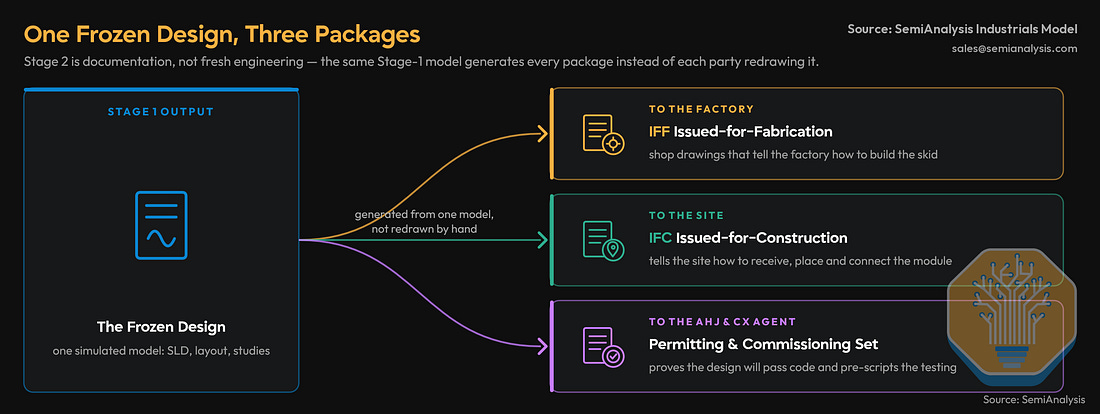
This stage is largely a documentation and paperwork exercise. Automating the Stage-1 design model lets these packages be generated from one source rather than be recreated by hand, removing the manual redrawing between parties (IFF and IFC serve different audiences, the factory and the field, and are issued separately; they are not the same document and do not drift against one another).
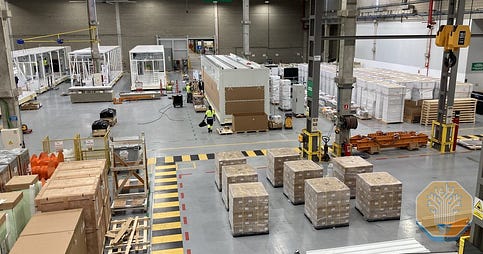
Once all the prework is completed, the module still has to be physically built. Think of this step as the production line, but in a much bigger scale of a datacenter. The assembly process starts with a base, a skid, or a frame that sets the foundation of the module. From there, equipments are layered in sequence, with each component placed into its designated area like how you will assemble a LEGO building.
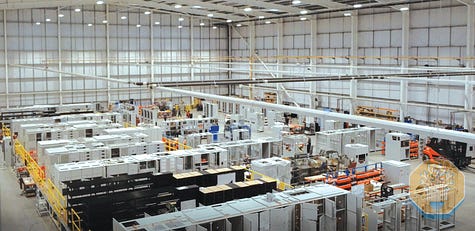
What runs alongside the assembly is the factory acceptance test, or better known as “FAT”. Testing happens at two levels. The first is at each station as the module is assembled, an inspection gate where the work is checked before the module advances. The second comes once the module is complete: the whole unit is powered up and run the way it will run on site to confirm its rated load and everything is in place properly. By the time it leaves the line, the module is cabled, labeled, sealed, and proven to work on its own.
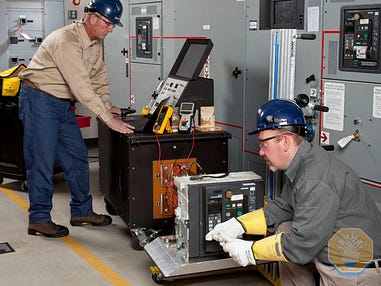
Factory testing is critical. The industry often describes this through the 1-10-100 rule: a defect that costs $1 to fix during design or assembly may cost $10 once production begins and $100 after the product has shipped. Furthermore, standardization also makes testing repeatable, so same FAT procedures can be run multiple times across production.
Now, the module leaves the factory’s controlled environment and runs into the uncontrolled area of site logistics. At the scale of today’s AI campuses, bringing the first block online is no longer enough, because operators also have to think about time to the last megawatt. The critical questions become how many finished modules can reach the site, how many can be unloaded and set in parallel, and how effectively limited rigging and installation crews can move from one block to the next.
In our conversations with datacenter developers, logistics appears as one of the main challenges equipment modularization presents. All these skids and modules are big and heavy, and shipping them from the factory to the site is not a minor task. That is why footprint and location matter so much, with integrators expanding their footprint to sit closer to their customer’s sites.
Federal law fixes the no-permit envelope at 102 inches wide and 80,000 pounds gross, leaving about 24 tons for the module on a standard deck. Microsoft’s Azure Modular Datacenter and Schneider’s Easy Modular ride inside a 40-foot ISO container at 96 inches wide, so they cross any state line or fly in a C-17 permit-free.
Past that threshold, you need a permit, although the truth is that permit cost has little impact and the real implication is on schedule. A standard oversize permit runs just $15-100 a state, and even the line-haul, at $12-14 a loaded mile, makes a 500 mile move only six to seven thousand dollars a trailer.
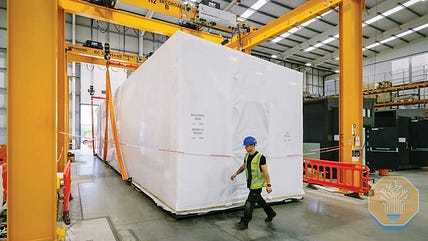
On time, loads past roughly 16 feet become superloads, triggering a bridge-engineering review that runs 7 to 21 days per state and stacks toward months across a route, and escorts force restricted travel windows. Besides, the thresholds are not even uniform, as a module engineered to clear Virginia (superload at 18 feet or 250,000 pounds) can still trip Ohio’s far lower 14-foot, 120,000-pound line.
Transport also becomes part of the reliability program. A module may experience greater mechanical stress on the road than during normal operation, particularly through vibration, braking, and loading. In one validation exercise, Aligned DC shipped a 3 MW module from Utah to Omaha and back with force loggers to measure the conditions it experienced in transit.
On top of all this, transport can also be constrained by the insurance it carries. High-value AI racks may be shipped only one or two at a time because concentrating too much equipment on a single trailer creates an unacceptable insured loss no insurance company is willing to bet on. The risk is not theoretical and we have heard cases where truck carrying large UPS module tipped over on a road in West Virginia while traveling toward Northern Virginia, leading to large reimbursement.
Considering all these implications, operators are designing around the haul, like AWS engineering Houdini’s skids onto low double-drop trailers to stay under bridges. Also Nautilus floated its datacenter 50 miles to the Port of Stockton on a barge, and Compass put a Schneider module factory next to its Red Oak campus. That said, some operators like DXN do manage to ship containers from their factories in Perth, Western Australia all the way to the US. These are, however, mostly smaller containers.