Original article
Stargate Abilene has become the symbol of America’s AI buildout. It is a gigawatt-scale campus on the Texas plains built for OpenAI. China has campuses on a similar scale, though few people outside the country have had a look inside. In September, we visited one, and we found the speed, scale, ultra low cost, and deep vertical integration astonishing.
During the trip, we toured Inner Mongolia, China’s fastest-growing AI datacenter region. It's the “West Texas” of China, but while the Lone Star State faces its highest ever anti-datacenter sentiment, Inner Mongolia is accelerating and faces no such backlash.
Our main stop was Galaxy, a campus in Ulanqab planned for up to 800MW of IT capacity.
Galaxy is about the size of Abilene’s core campus. Its first 120MW phase was delivered within a year at a fifth of US costs. All four phases are built-to-suit for two internet giants.
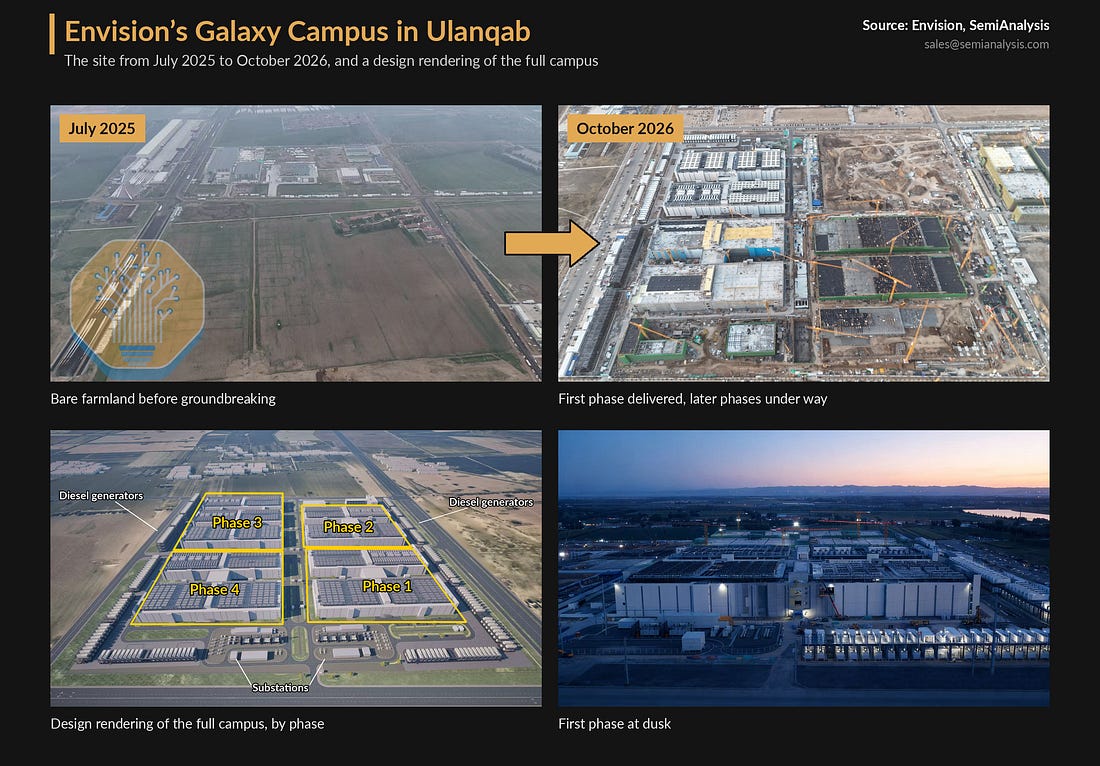
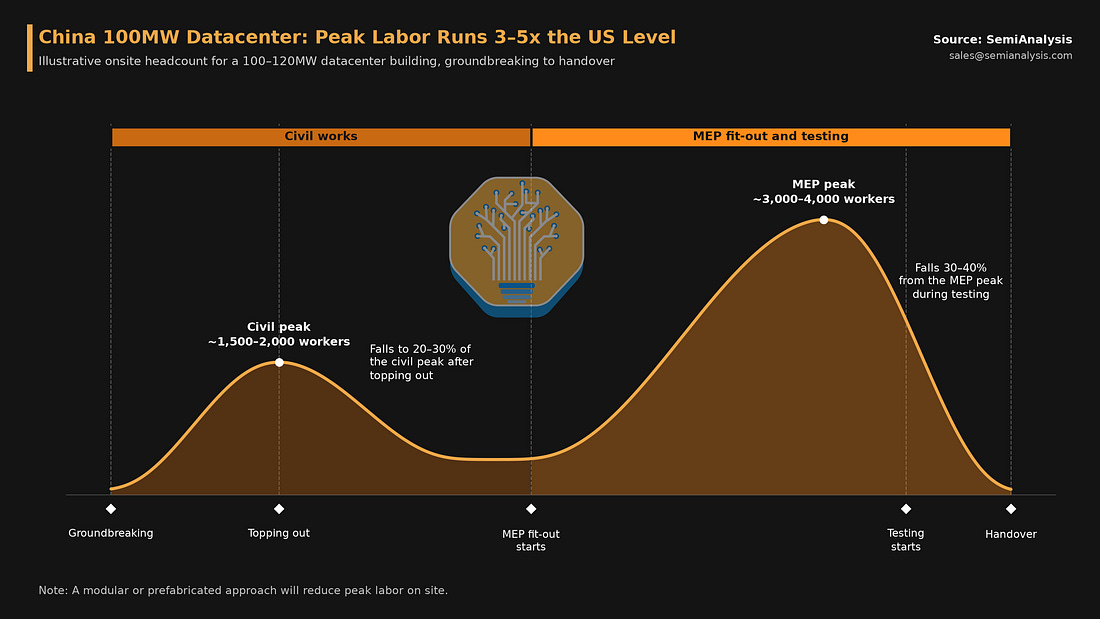
When we visited, the rest of the campus was still a busy construction site, and the surrounding Chahar High-tech Zone had nearly 30,000 construction workers on site across 22 datacenter projects according to a local report. As we noted in our primer on the China datacenter market, with this much labor available, Chinese datacenters rarely take a fully modular approach, yet construction costs keep falling. We take a closer look at why in this report.
The datacenter is owned by Envision Group, a renewable systems integrator with more than 100GW of wind turbines installed worldwide. It came to datacenters from energy management, a path many others are taking today. Yet it is one of the most vertically integrated players we have ever seen.
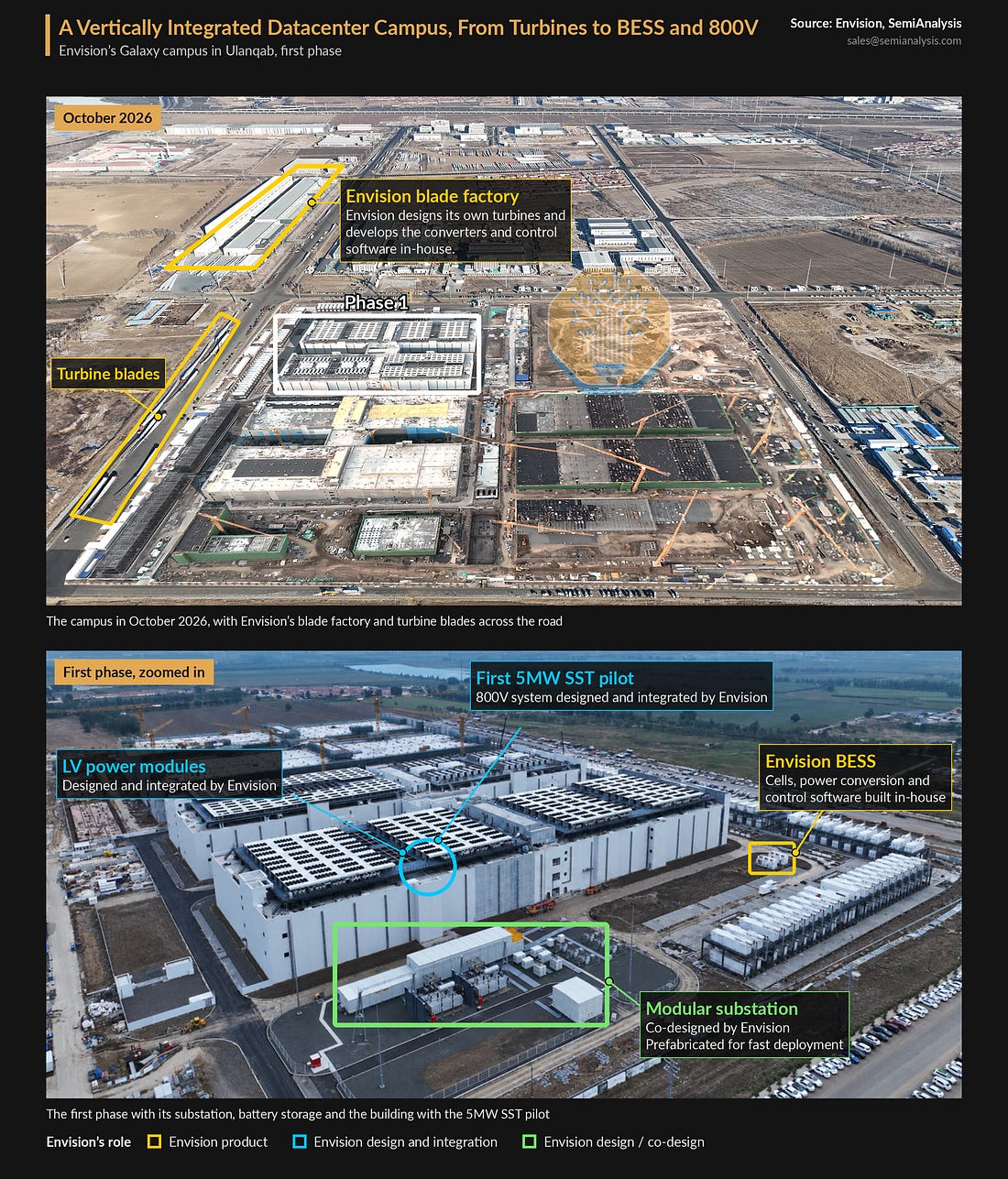
Beyond running the datacenter, Envision builds its own wind farms and a dedicated power line to supply it. Its blade factory sits just across the road from the Galaxy datacenter campus, with finished blades stacked in the yard.
Inside the campus, it designed and integrated the low-voltage power modules and the 800V system, manufactured the battery storage that smooths the load, and co-designed the prefabricated substation.
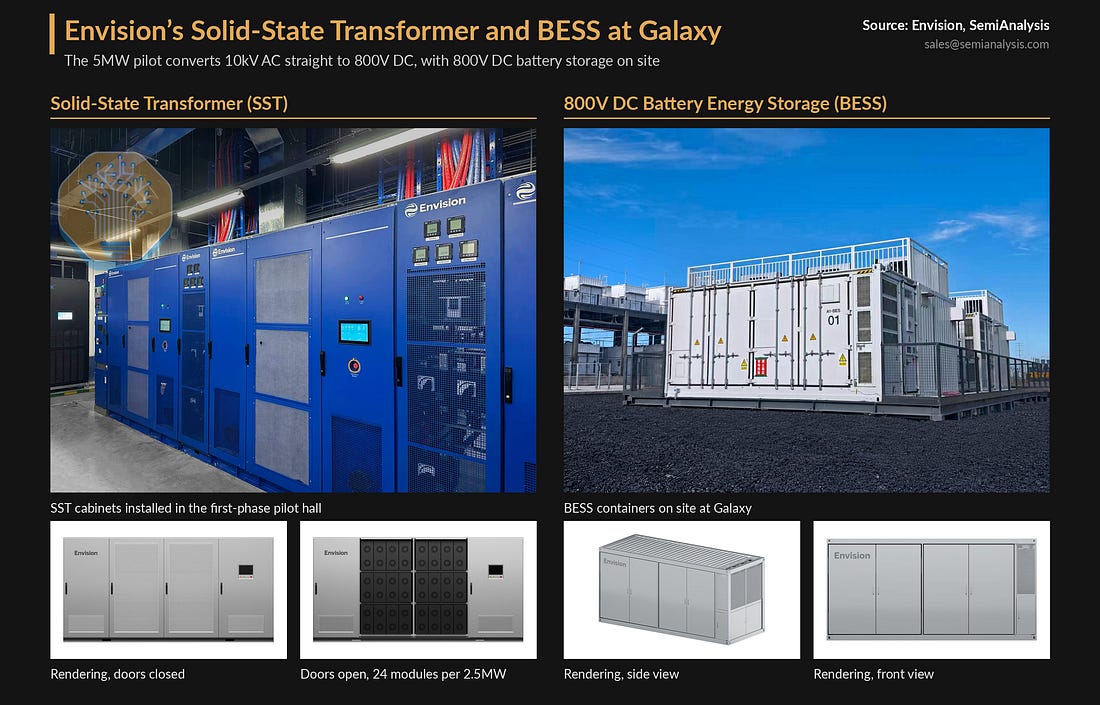
In one 5MW hall, we saw the 800V system at work. Solid-state transformers (SSTs) take 10kV AC from the grid and convert it straight to 800V DC for the racks. This removes the low-voltage transformers, UPS and rectifier stages in between. The same architecture is still on the US roadmap, as we outlined in our 800V DC deep dive.
In China, datacenters have been running on DC power for almost two decades, from China Telecom’s 240V DC pilots in 2007 to Alibaba’s Panama power system in 2018. Today, roughly a quarter of Chinese datacenters built in the past decade run on DC, while about 97% of US datacenters still use AC UPS. An SST is a natural next step on that path, and we cover the evolution and the pilot in detail later in this report.
On cooling, Galaxy uses a design common in Inner Mongolia. Liquid- and air-cooled servers share one water loop, with no central chiller plant. Nvidia says Vera Rubin can run on 45°C water without chillers, yet most datacenters in the US keep one for air-cooled equipment and for the flexibility to shift between the two. Galaxy drops the central chiller and keeps much of that flexibility, a design that has been running at scale in northern China for years.
In this report, we use what we saw on the site visit to show how China builds hyperscale datacenters today, with a deep dive on each of the topics above. Many questions still open on the US roadmap find a reference point here.
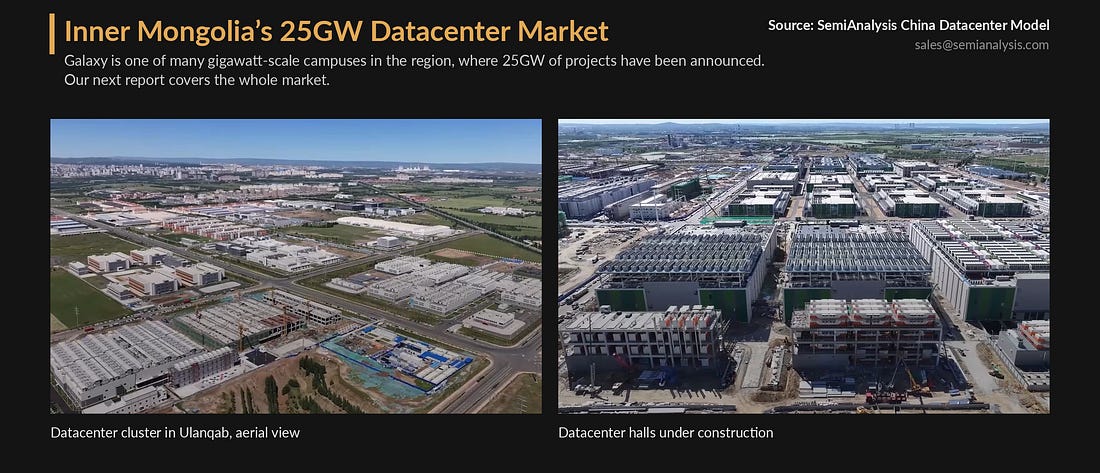
Our next report will take a wider view of Inner Mongolia’s datacenter market. The region has lined up 25GW of announced datacenter projects, including several gigawatt-scale campuses. Many reports picture it as a land of empty datacenter halls. Our data tells a different story. Few have asked what limits datacenter development there. We look at each constraint, from power to land and water. Stay tuned.
The SemiAnalysis China Datacenter Model
This trip was part of our ongoing fieldwork for the SemiAnalysis China Datacenter Model, the China counterpart to our global SemiAnalysis Datacenter Model.
It tracks over 1,000 facilities across 70+ operators, with quarterly delivery curves through 2032, a lease signing and delivery tracker, and EDWC hub and cluster analytics. Every project in our report is tracked in the model.
Contact sales@semianalysis.com for more information.
China’s Stargate campus
Envision comes to datacenters as a renewable systems integrator. Beyond building wind turbines, it designs, integrates, and manages power systems across the full chain, from generation and storage to computing loads. Its affiliate, Envision AESC, develops and integrates batteries, energy storage systems, and the power electronics and software that link them.
Inner Mongolia has far more wind than its existing industry and population can use, so policy encourages bringing new demand to where the renewable resources are. In Chifeng, Envision built a 2GW off-grid wind, solar and storage system that feeds a green ammonia plant. The system runs entirely on power electronics, with no synchronous generator. A small pilot datacenter built with Tencent’s modular T-Block units runs on the same system. Galaxy is a larger application of the same idea.
This is a pattern we see across China right now. Industrial groups with an edge in energy, construction or electrical equipment are pivoting into AI infrastructure. Project returns are thin, with IRRs squeezed hard, so the reward often comes from elsewhere. For Envision, datacenters create new demand for the power and equipment it already produces. For many listed companies, the draw is the stock market.
Of these newcomers, Envision is one of the most ambitious. Its datacenter plans in Inner Mongolia add up to 3GW. Galaxy is the first. Its initial phase was delivered in August 2026, and the full campus is expected to be completed by the end of 2027.
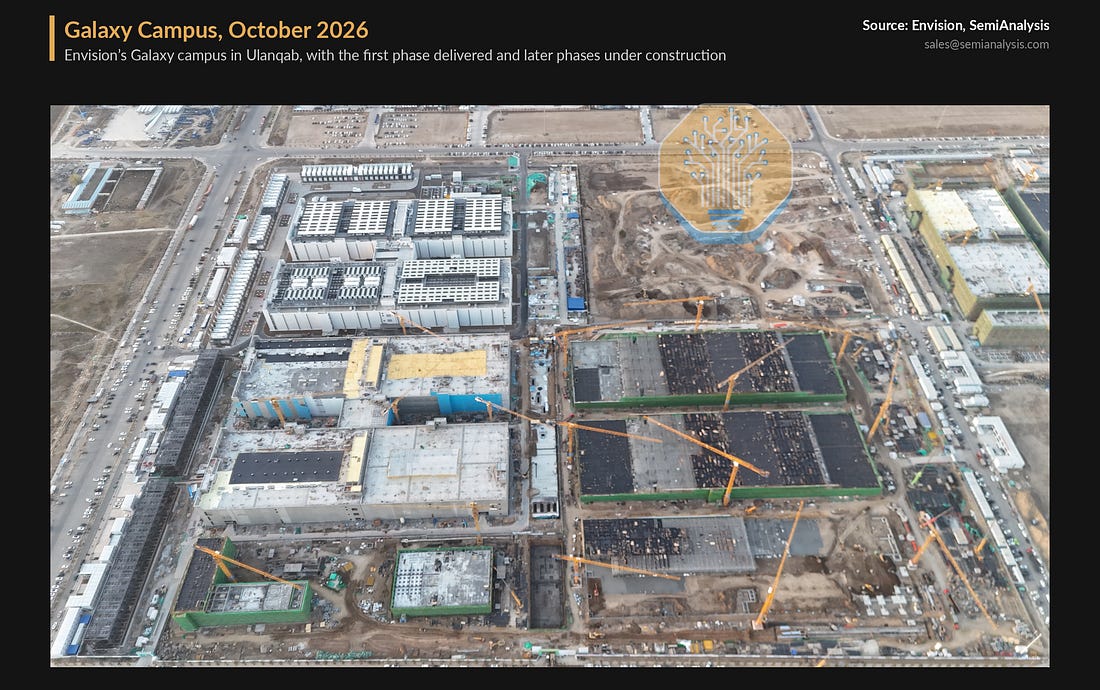
The scale of the campus invites comparison with Stargate’s flagship campus in Abilene, Texas. Crusoe began building Abilene in mid-2024 and leased it to Oracle, which runs it for OpenAI. Crusoe describes the eight-building campus as 1.2GW of power, which comes to about 820MW of critical IT capacity, on par with the 800MW planned at Galaxy. That makes Galaxy one of the largest single campuses in China. Our SemiAnalysis Datacenter Model also tracks an expansion phase that Crusoe plans to add, powered behind the meter, which takes the whole Abilene site to 1.5GW of IT capacity. Galaxy also has room to grow. If the wind turbine factory next to the campus is converted, a later expansion phase could take the campus to ~1GW.
In addition to scale, the two share a starting point. Both are developed by companies with roots in energy, and both were planned around their own power. Abilene draws on the grid and on gas turbines on site, while Galaxy relies largely on wind.
What sets Galaxy apart from Abilene, and what draws our attention, is its vertical integration.
Own wind for its own load
Galaxy’s power comes through a model China calls source-grid-load-storage (”SGLS”). Under this model, a project builds its own wind and/or solar farm, battery storage and datacenter, and links them through a dedicated line instead of the public grid.
For hyperscalers, the appeal of an SGLS project is long-term power at a largely fixed cost. Power from wind and solar also counts toward green targets.
Inner Mongolia holds about 57% of China’s usable wind resources. A wind farm here runs on average about 2,800 full-load hours a year, a capacity factor of roughly 32%. Ulanqab is windier, with a capacity factor of 35–40%. That sets the starting point for how much of an SGLS project’s power can come from wind.
For Galaxy, Envision aims to supply over 60% of the first two phases’ power use with its own wind farms. Three factors make this possible:
Siting. Envision chose windy sites, even though they sit about two hours’ drive from the campus. The two wind farms are about 80km apart, which cuts the hours in a year when neither has wind.
Scale. The wind farms have a combined 420MW of installed capacity, about 1.75 times the 240MW datacenter load. With this oversizing, even light-wind hours can still cover much of the load.
Storage. A 4-hour battery storage system shifts power from windy hours into calm ones. Most SGLS projects add storage too, but Envision makes its own storage systems and runs them on its own software, which we detail in the next section.
The chart below shows how each factor raises the wind share, using illustrative curves.
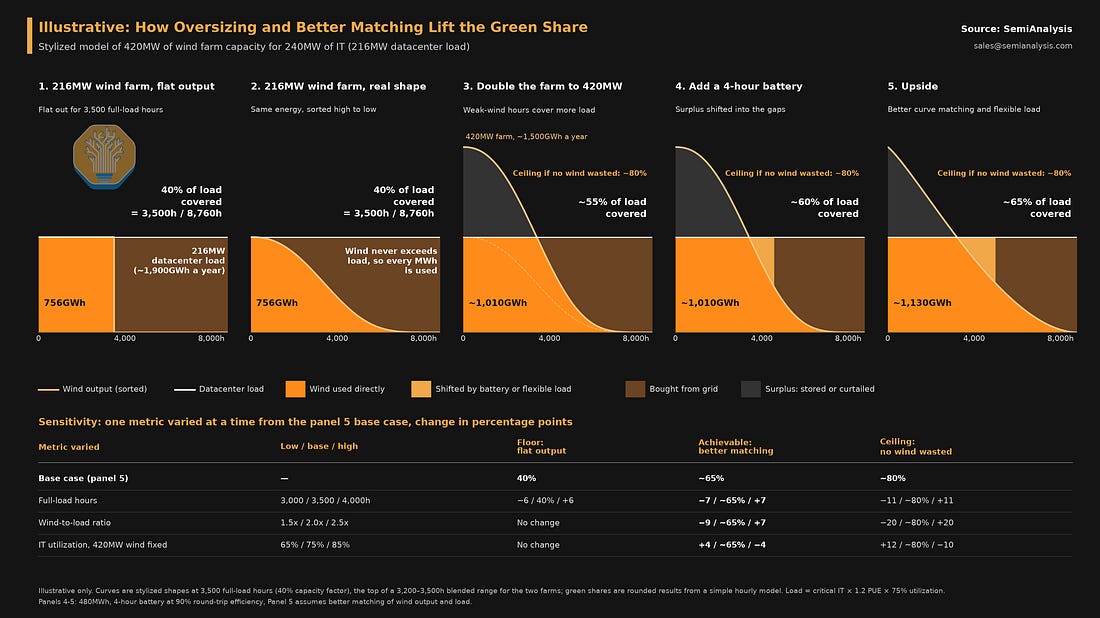
Panel 1 starts with a simple case: 1MW of wind for every 1MW of datacenter load. A good site in Ulanqab produces as much power in a year as running flat out for about 3,500 hours. To keep it simple, the panel shows the farm at full output for 3,500 hours and at zero for the rest of the year. Wind covers 40% of the year’s power.
Panel 2 shows a more realistic picture. Wind output goes up and down, so the panel sorts every hour of the year from windiest to calmest. The farm is the same size as the load, so it never produces more than the campus uses. All its power gets used, and wind still covers 40%.
Panel 3 doubles the wind farm. Output in every hour doubles too, so even light-wind hours now cover much of the load, and wind’s share rises to about 55%. The cost shows in the gray area. In windy hours, the farm produces more than the campus can use, and that power must be stored or curtailed.
Panels 4 and 5 show what can be added on top. A 4-hour battery moves some surplus into the hours after the wind drops, though it cannot help much when the wind stays calm for days. Better matching between wind output and load can push the share even higher.
The table at the bottom shows how the result changes with wind quality, the size of the wind farm relative to the load, and how fully the datacenter is used.
Inside the campus: developer, designer and integrator
Beyond pairing energy production with consumption, Envision is also integrated inside the campus, acting as more than a developer and operator. The chart below shows its three roles, in three colors.
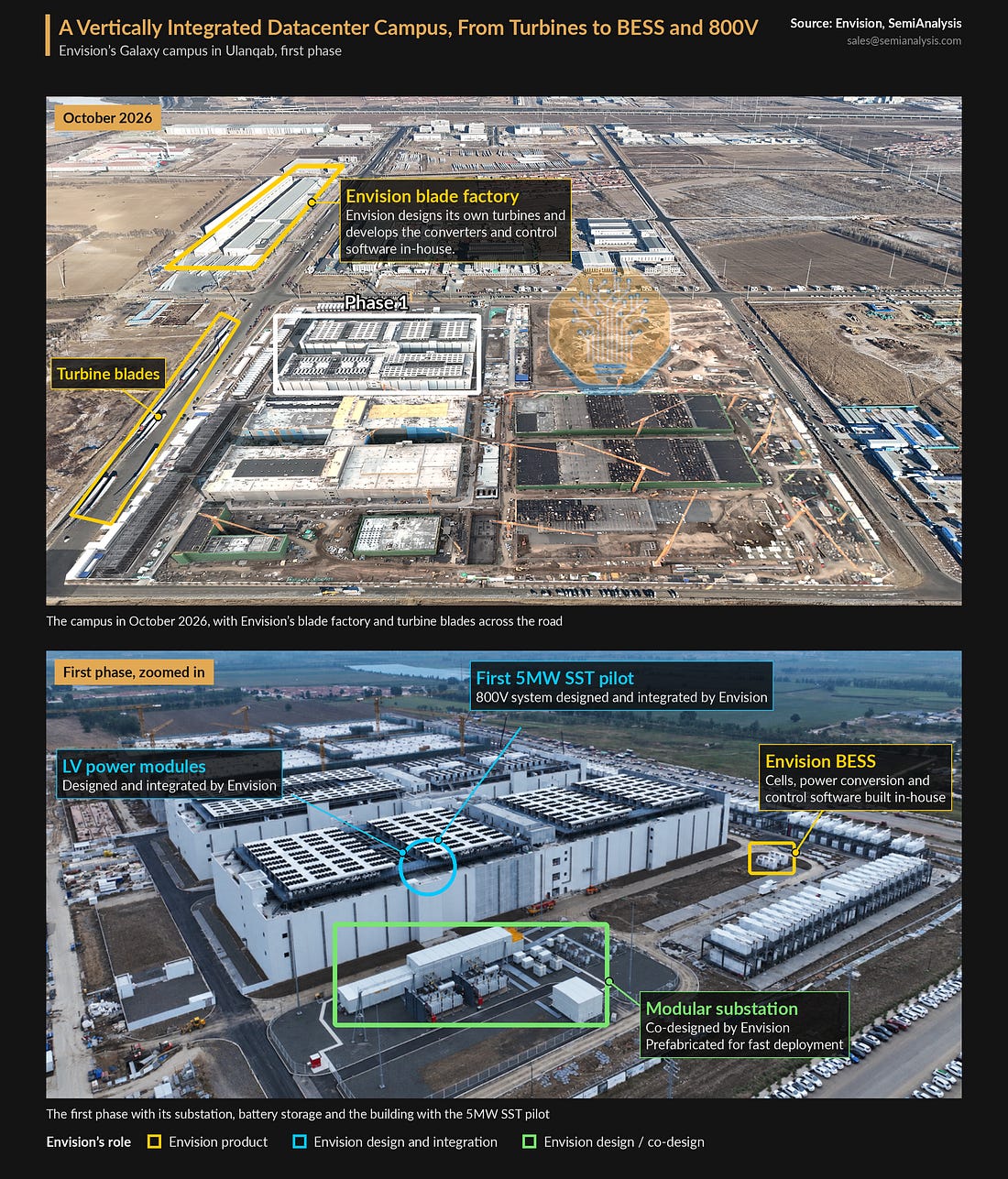
The first is as a manufacturer. Envision designs its own turbines and develops the converters and control software. The battery energy storage systems (BESS) at both the datacenter campus and the wind farm come from its affiliate AESC, which builds every major part in-house, from cells to power conversion and software, so the whole system can be tuned and tested together at the factory before shipping. Most vendors cover only one part of the system (high voltage, low voltage or generators), so getting the parts to work together falls to on-site commissioning, which can take 3–6 months. Envision’s factory pre-configuration has become its core selling point.
The second role goes beyond Envision’s traditional business into the datacenter space. For Galaxy, Envision designed and integrated the low-voltage power modules and the 800V SST system.
800V DC is the architecture that Nvidia is pushing for its next generation of high-density racks, as Kyber racks at around 600kW cannot be served efficiently at today’s voltages. In the US, the industry is still early on this path. SSTs that convert medium-voltage AC straight into 800V DC are the final step. Galaxy’s SST pilot is only 5MW, but it already runs 800V DC all the way to the rack at a live hyperscaler site. We discuss this in detail shortly.
Lastly, Envision co-designed the prefabricated substation sitting inside the campus. The substation is built and tested as modules in the factory while civil work goes on at the site, then shipped and connected on site. This takes less than 3 months, versus about 6 months for a conventional indoor substation.
Today, vertical integration on its own does not lead to hyperscaler orders, but two trends suggest it could matter more over time.
First, access to power is becoming central to datacenter development. In the US, developers bridge the power gap with on-site gas turbines, fuel cells and batteries. In Southeast Asia, governments have been pushing developers to bring their own power this year. Malaysia now requires datacenters to source at least 30% of their power from renewables and encourages on-site generation. In China, approvals increasingly favor projects that pair compute with green power, under the national push for “Compute Power Coordination.” Across different markets, access to energy is becoming part of what a datacenter developer sells.
Second, the power architecture from the grid connection to the rack is being redesigned. In the US, the industry is moving toward higher-voltage DC power, while battery backup units (BBUs) and BESS are starting to take over the role of UPS. The technology roadmap is not settled yet, but the shift looks set to continue, giving integrated players room to compete differently from traditional developers.
These trends have drawn other players onto a similar path. The closest case is the tie-up between VNET, CATL and Zhongheng Electric.
VNET is a leading colocation operator, CATL is the world’s largest EV battery maker, and Zhongheng Electric is China’s largest supplier of HVDC power systems for datacenters, working with both Alibaba and ByteDance.
In 2026, CATL became VNET’s largest shareholder and announced a deal to take a 49% stake in Zhongheng Electric’s controlling shareholder. It has since agreed with VNET to jointly develop gigawatt-scale datacenter campuses, and separately with Zhongheng to work on datacenter power systems. Between them, VNET covers the datacenter side, CATL leads green power and storage, and Zhongheng brings power conversion inside the hall.
CATL is also one of DeepSeek’s largest outside investors, which extends its reach downstream to the model layer.
Where Envision builds most of the pieces in-house, CATL links them through partnerships and equity stakes.
China’s datacenter market is highly competitive. Rents have roughly halved over the past five years, to about $40/kW/month excluding power. Capex has fallen about 25% over the same period, to less than $3mm per MW. Power in Inner Mongolia costs about $0.055/kWh all-in, among the lowest in the world.
In a market like this, owning more of the value chain is one way to differentiate, a playbook familiar from China’s EV market, where players like BYD make much of what goes into their cars.
It is too early to say whether vertical integration will become a meaningful advantage in China’s datacenter market. For now, it gives integrated players more control over cost and schedule, but hyperscalers still choose vendors mainly on resources and track record. That could change as power becomes harder to secure and the power system inside the datacenter is redesigned.
Behind the paywall, we walk through how Galaxy was built and designed in detail.
On speed and cost, we follow Galaxy from land auction to customer acceptance and explain why capex keeps falling.
On power, we trace how China took a different path from the US, adopting 240V DC in its datacenters years ago, and walk through Galaxy’s live 5MW pilot. A larger version is planned for the next phase.
On cooling, we take apart a design common in northern China that offers one answer to the chiller debate in the US.